Caps and instalments
Plinko withdrawal limits when a big bin meets a weekly cap
One rare edge-bin landing can leave a balance bigger than the ceiling a cashier will release per period. These are the caps, instalment rules and minimums the ranked casinos print, with the clause for each.
Plinko withdrawal limits are the lines in a casino's terms that set a ceiling on each payout period and say what becomes of any balance above it. They matter more for this game than their dull wording suggests, because a board with a long paytable can turn a small stake into a sum far above an ordinary cap in a single drop. Knowing the ceiling before the ball falls turns a surprise into arithmetic.
Every figure below comes from the ranked casinos' own terms, with the clause number, so you can open the same wording yourself. Timing of payouts is not covered here; only amounts, periods and conditions are. The same casinos, scored on identity rules and licence registers rather than on payout size, sit together on the plinko casinos page.
How plinko withdrawal limits are usually built
Limit clauses look different from one operator to the next, but most are made of a few parts:
- A cap per period: a ceiling per 24 hours, week, month or rolling 30 days.
- A cap that switches on after a large win: ordinary requests are untouched, a big result is spread out.
- Instalments: a large sum is paid in equal or capped parts over several periods.
- A minimum: the smallest amount the cashier will send.
- Operator discretion: the terms say the operator sets the figures, and the cashier shows them.
A single casino can combine several of these. Read the whole clause, not only the first figure in it.
The caps in the ranked casinos' terms
- Vave: cl. 8.8 sets no periodic ceiling, though winnings of 50,000 USDT or more can, as an exception, be split into equal parts.
- Bitcasino.io: large requests are handled to a weekly ceiling of 1 million USDT (cl. 6.10).
- Rocketpot: US$5,000 a month after a large win (cl. 11.5); from US$5,000 the sum is paid in instalments of at most US$5,000 a month.
- Winz.io: 100,000 USDT a week and 400,000 USDT a month (cl. 11.7).
- Blockbet: a monthly €10,000, cut to €5,000 once the balance reaches tenfold the sum deposited (cl. 8.6).
- Metaspins: no upper cap; large sums are paid in instalments (cl. 12.5).
- Rainbet: no upper cap, with a US$15 minimum (cl. 8.1).
- TG.Casino: €150,000 per rolling 30 days (cl. 9.6).
- Winna: US$10,000 per 24 hours (cl. 8.7).
- Bitsler: the operator sets the minimum and the maximum (cl. 8.6), so the cashier screen holds the current figures.
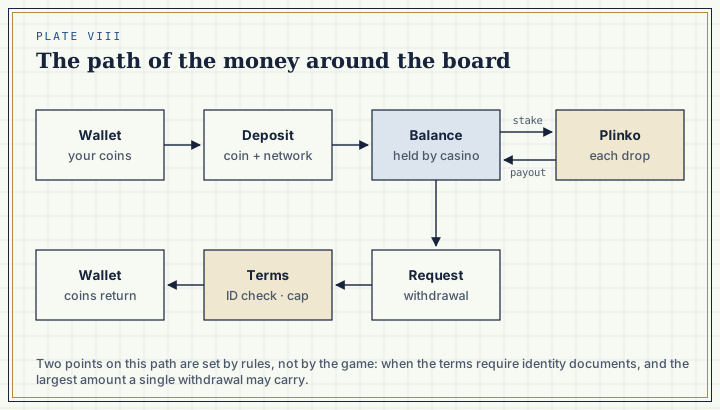
For Sportsbet.io, Shuffle.com and Hyper Lucky the limit column of the ranking table shows a dash: no figure is on record, so look for a limit clause in their terms before depositing.
Notice Blockbet's second figure. Its lower ceiling is tied to the ratio between balance and deposits, which is exactly the situation a lucky drop creates.
A big bin against plinko withdrawal limits: a worked example
BGaming's own game page, read 16 September 2026, prints a top multiplier of 1,000× for its Plinko, and Hacksaw Gaming's page prints a maximum win of 3,843.3×. Neither page says in which bin or on which setting that value sits, so the setup below is invented for the arithmetic.
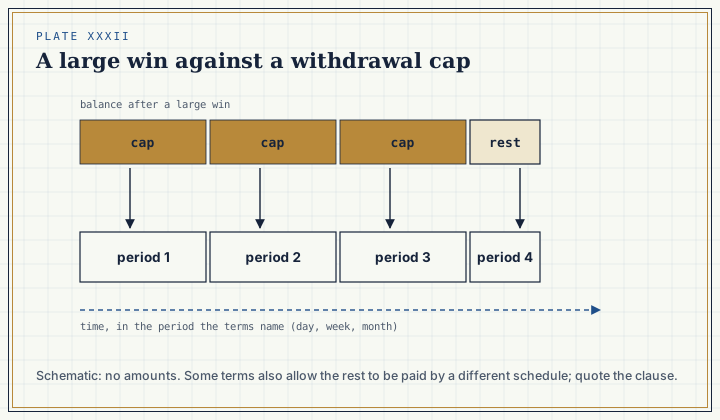
Imagine a made-up paytable on a 16-row board with 1,000× in both edge bins, and a stake of US$20. On a board where each peg splits evenly, one edge bin has 1 route out of 65,536, so the two edges together are reached about once in 32,768 drops on average. A landing there turns US$20 into US$20,000.
Now hold that hypothetical balance against three of the caps above:
- Winna, US$10,000 per 24 hours (cl. 8.7): two periods to take out the full sum.
- Rocketpot, US$5,000 a month after a large win (cl. 11.5): four monthly parts.
- Winz.io, 100,000 USDT a week (cl. 11.7): the example sum sits well inside a single week.
The same win is one request at one casino and four months of instalments at another. Nothing about the drop changed; only the clause did. If you want to see how rarely that edge bin turns up at other heights, the bin-by-bin probability tables lay out the counts.
Instalments: when a large result is paid in parts
Three ranked casinos write instalments into their terms. Vave uses them only as an exception, for wins from 50,000 USDT, in equal parts (cl. 8.8). Rocketpot applies them from US$5,000, with each part capped at US$5,000 a month (cl. 11.5). Metaspins keeps no upper cap but pays large sums in instalments (cl. 12.5) without printing the size of a part.
While instalments run, the rest of the balance usually stays in the account. That has a practical side: a balance left in a casino account can be staked again. Deciding in advance to leave the remainder alone is a simple limit you set for yourself, and it fits with the stop settings discussed in the post about autoplay.
Deposit wagering before any payout: Vave cl. 8.11
Vave's terms add a condition that comes before any cap. Clause 8.11 wants stakes worth three times each deposit placed on casino or live games, or stakes equal to the deposit on sports, before money can go out.
A made-up example: a deposit of 200 USDT used on casino games needs 600 USDT of stakes first. At 2 USDT per drop that is 300 drops, and at 0.50 USDT it is 1,200. The requirement counts turnover, not profit, so a session that ends level still counts towards it. The same logic applies when a bonus is involved, and the wagering attached to an offer is written separately from this deposit rule.
Minimums and discretion
A cap is the top end; the bottom end matters too. Rainbet prints a US$15 minimum in cl. 8.1, so a balance under that figure stays in the account until it grows or is played. Bitsler leaves both ends to the operator in cl. 8.6, which means the numbers you see in the cashier are the ones that apply that day.
Small balances and network fees meet at this point. Suppose, as an example, a balance of US$18 at a casino with a US$15 minimum: the request clears the line, but a coin network fee is then taken from what is sent, so the amount reaching the wallet is lower than the figure typed into the cashier. The smaller the sum, the larger that fee is as a share of it.
Reading plinko withdrawal limits before the first deposit
- Open the terms and search for «withdrawal», «limit» and «instalment».
- Note the period: 24 hours, a calendar month and rolling 30 days are not the same.
- Look for a second figure that applies after a large win or at a balance-to-deposit ratio.
- Check whether a wagering condition on deposits comes first.
- Find the minimum and compare it with the stakes you plan to use.
- Read the identity clause alongside, since several clauses tie a check to a payout request, as the page on ID requests explains.