Counting routes by height
Plinko row count explained, from 8 rows up to 16
Adding rows adds pegs, bins and routes, and it changes how often the far edges are reached. Here are the route counts for 8, 12 and 16 rows, with the arithmetic laid out so you can repeat it.
Plinko rows are the horizontal lines of pegs a ball has to pass on its way down, and the row setting is the one control that reshapes the board itself. This page counts the routes for three common heights, 8, 12 and 16, and shows what the extra pegs do to the middle of the board and to its edges. Every number here is plain arithmetic that you can check with a calculator.
Why the plinko row count sets the number of routes
Each row is one left-or-right decision. On a board where every peg splits evenly, one decision doubles the number of possible routes, so a board of n rows has 2ⁿ of them and n + 1 bins underneath. That arithmetic describes the board alone; which casinos actually run one is a separate question settled on the crypto plinko sites page.
- 8 rows: 2⁸ = 256 routes into 9 bins.
- 12 rows: 2¹² = 4,096 routes into 13 bins.
- 16 rows: 2¹⁶ = 65,536 routes into 17 bins.
The bin a ball ends in depends only on how many of its decisions went right. That means the routes into bin k are the number of ways to pick k right turns out of n, written C(n, k). The whole shape of the board follows from that one formula, which is also how the explanation of a single drop reaches its counts.
Plinko rows at 8, 12 and 16, bin by bin
8 rows
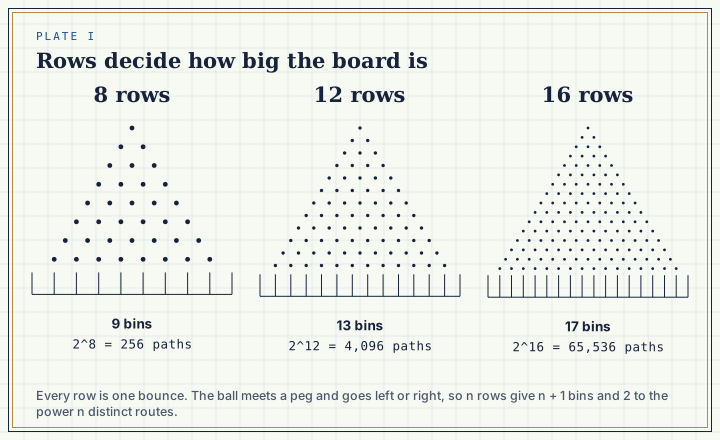
Counting from the left edge to the right edge: 1, 8, 28, 56, 70, 56, 28, 8, 1, which adds up to 256. The centre bin takes 70 routes, or 27.3%. Each edge takes one route, 0.39%, so an edge bin is reached about once in 256 drops on average.
12 rows
From the edge to the centre: 1, 12, 66, 220, 495, 792, 924, then back down the other side, adding up to 4,096. The centre bin holds 924 routes, 22.6%. Each edge bin keeps its single route, which is now 1 of 4,096, or 0.024%.
16 rows
From the edge to the centre: 1, 16, 120, 560, 1,820, 4,368, 8,008, 11,440, 12,870, then the same counts in reverse, adding up to 65,536. The centre bin holds 12,870 routes, 19.6%. Each edge bin still has exactly one route, and one route out of 65,536 is 0.0015%.
The percentages for every bin at all three heights appear together on the table of bin probabilities.
What a higher plinko row count does to the shape
Two things happen at once when rows are added, and they can seem to pull in opposite directions.
First, the ball spreads across more bins. The spread of the bin number, measured as a standard deviation, is the square root of n divided by 2. That comes to about 1.41 bins on 8 rows, 1.73 on 12 and exactly 2 on 16. The three middle bins together catch 71.1% of drops on 8 rows, 61.2% on 12 and 54.5% on 16, simply because there are more bins to share the traffic.
Second, the far edges become dramatically rarer. The spread grows only with the square root of the rows, while the board gets wider in step with the rows themselves. Relative to its width, the hump gets narrower, and the tails thin out fast.
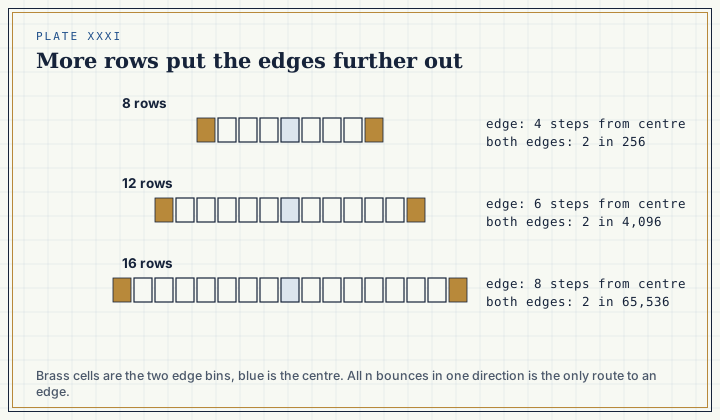
A useful way to see it is to take the two outermost bins on each side, four bins in total:
- 8 rows: 18 routes of 256, 7.03%, about one drop in 14.
- 12 rows: 26 routes of 4,096, 0.63%, about one drop in 158.
- 16 rows: 34 routes of 65,536, 0.052%, about one drop in 1,928.
So a taller board spreads the ball more widely across the centre while making the very outside almost untouched. A plinko row count of 16 does not move the ball towards the edges; it moves the edges further away from the ball.
Plinko 16 rows, worked through
Sixteen is the tallest of the three heights on this page, and it is where the arithmetic is most striking. Here is plinko 16 rows followed through from routes to what they mean at the paytable.
Step 1: the chance of one particular edge
One route of 65,536 leads into the left edge bin. The same is true of the right edge. For either edge, add them: 2 of 65,536, or 1 in 32,768.
Step 2: how many drops before an edge is likely
The chance of missing both edges on one drop is 32,767 in 32,768. The chance of missing them on every one of d drops is that fraction raised to the power d. Working it through:
- 1,000 drops: about a 3.0% chance of seeing at least one edge.
- 10,000 drops: about 26.3%.
- 50,000 drops: about 78.3%.
For one particular edge, the left one say, you need roughly 45,400 drops before the chance of having seen it passes one half.
Step 3: what that means for a paytable
Whatever number a studio prints in the edge bin, its share of the long-run return is its multiplier times 2 in 65,536. As a hypothetical, an edge bin printed 500× would add only about 1.5 percentage points to the whole table's return. The multiplier tables page carries that sum through a full made-up 16-row table.
The same session length at three heights
It helps to fix the number of drops and compare heights, because a budget is usually spent over a set number of drops rather than a set number of routes. Take the chance of seeing at least one of the two edge bins:
- 8 rows, 200 drops: about 79.2%. An edge visit is an ordinary event.
- 12 rows, 1,000 drops: about 38.6%. It may happen once in a long evening, or not at all.
- 16 rows, 1,000 drops: about 3.0%. Most people who drop a thousand balls at this height will never see either edge.
The same fact reads the other way for the centre. Short boards give big shares of drops to one or two bins, so results cluster tightly around what the middle of the paytable pays. Taller boards spread results over more bins, and the rare corners of the table sit so far out that a session tends to be decided by the neighbourhood of the centre rather than by the extremes.
Plinko rows, risk levels and paytables together
Row count and risk level are separate controls. Rows change the routes; risk changes the numbers printed under the bins. A board that offers several heights needs a separate paytable for each, because a table built for 8 rows would give very different returns if laid under 16.
The three heights on this page sit inside the range two studios print on their own Plinko pages, read 16 September 2026: BGaming lets players choose from 8 to 16 lines, and Hacksaw Gaming from 8 to 16 rows.
That is why the numbers in the bins shift every time you change the row setting, even with the risk untouched. The page on risk settings compares two made-up tables on the same height.
Nothing about the row setting changes the fairness of a single peg, and no height makes a given bin predictable. Choosing between plinko rows at 8, 12 or 16 is a choice about how widely results can swing and how far away the extremes sit, not a way to tilt the long-run return.