Territory clauses, read closely
Plinko sites by country: reading a casino's territory clause
Whether a casino opens an account for you is decided by a list the operator writes into its own terms. This page shows where that list tends to sit, who shapes it, when it applies and how to read it.
Asking where to play plinko is really asking two questions at once. The first is which casinos have the board in their lobby, and the ranking answers that from lobbies seen on 16 September 2026. The second is whether a given casino will open and keep an account for someone signing up from a particular place, and only that casino's territory clause can answer it.
This page is about the second question. It names no country as a destination and suggests no way round a list. It explains how to find the clause, how it is put together, and why reading it before the first deposit saves trouble later. The lobby side of that split — which casinos show Plinko at all — is what the crypto plinko sites ranking sorts through first.
Where to play plinko starts in the terms, not the lobby
A lobby tile tells you the game exists on a site. It says nothing about whether the site deals with your sign-up address. That information lives in the operator's terms, and it is written by the operator for its whole platform: Plinko, slots, live tables and sports all fall under the same clause.
So flip the habit of opening the games tab first. Find the territory clause first, confirm that nothing in it concerns you, and only then look at which Plinko versions the lobby carries. The list of numbered casinos gives you the lobby side; the terms give you the rest.
Where casinos print the list
Operators do not agree on a single place for it. When reading any casino's documents, these are the usual spots:
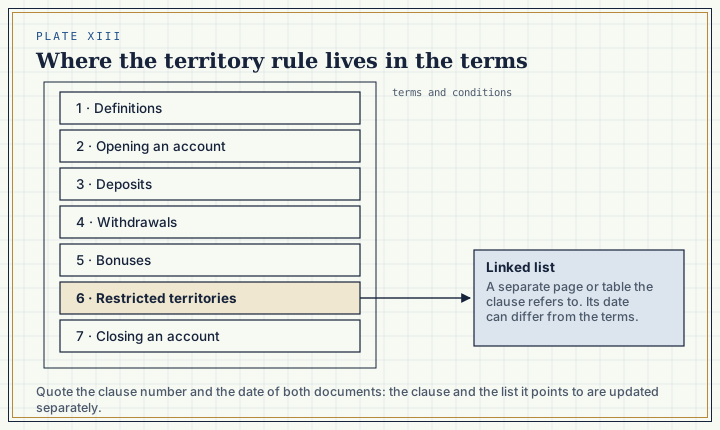
- The general terms, in a section on opening an account or on who may use the service. It often sits near the age requirement.
- A separate page of restricted territories, linked from the footer or from inside the terms.
- The sign-up form, where a country selector may leave some entries out. A missing entry is a hint, not the full rule.
- The help centre, in an article about account eligibility.
- Bonus terms, which can exclude further places from a particular offer while the account itself stays open.
If the terms and a help article disagree, the terms are the document the operator will rely on. Jot down which clause holds the list and on what day you saw it, since operators can edit it at any time.
Who sets the list
The list is set by the operator, and it reflects the conditions attached to its licence as well as the operator's own business choices. Two casinos holding licences from the same issuing authority can still print different lists, because each adds places for its own reasons.
The ranked casinos show how varied the licence side is. Bitcasino.io, Sportsbet.io, Shuffle.com and Bitsler appear in the Curaçao register under their own domains. Blockbet appears in the Anjouan register, and Winz.io is listed there too while its terms also cite a Tobique licence. Winna's terms point to a Tobique holder. Metaspins prints an Anjouan number in its terms while the Curaçao register lists it, and Vave's certificate names a different domain from the one it trades on. The page on licence lookups goes through those entries.
None of that tells you what a particular list contains. The only reliable source is the clause itself.
Plinko sites by country: why a long list can be a code sheet
A search for plinko sites by country suggests there is a map somewhere with casinos pinned to it. There is no such map, because every operator draws its own line, and the same casino can change it overnight.
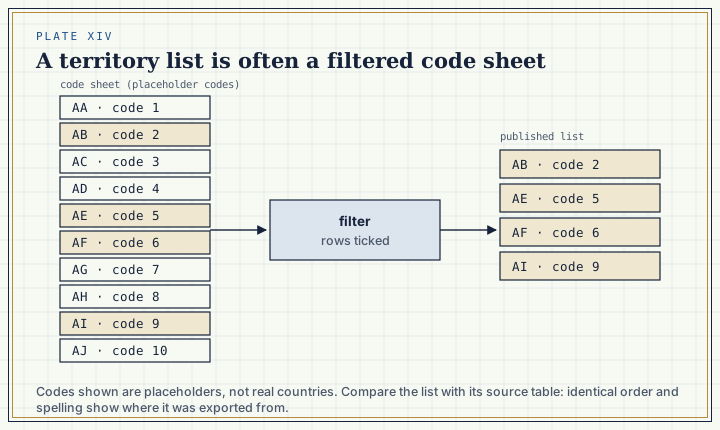
When you open a territory list, its length can be misleading. Some lists run to dozens of entries, including small islands and overseas departments that seem oddly specific. Very often that is a standard sheet of country codes copied into the terms: complete, alphabetical and not written with any one market in mind.
Two consequences follow:
- An entry that seems strange is still binding. A code sheet is blunt, and it applies exactly as written.
- Absence from the list is not an invitation. Terms often add a general sentence elsewhere that lets the operator refuse or close accounts in further places, and that sentence works alongside the list.
So reading plinko sites by country as a simple yes-or-no lookup misses half the clause. Read the list and the sentences around it.
Where to play plinko once the account exists: when the clause applies
A territory clause does its main work at sign-up. The address you register, the details on your documents and the place your account is used from all need to fit it. It keeps applying afterwards, too.
The clause usually connects to the identity rules. Document requests normally include something showing your home address, and an address that falls inside the list can put the account and its balance under the operator's terms for such cases. The moments and deadlines for those requests are set out on the page about ID clauses.
That is the reason to read before depositing, not after a good session. A clause discovered at the cash-out stage is the most expensive way to learn what it says.
Plinko gambling countries as a search phrase
People typing plinko gambling countries into a search bar usually want a quick answer to a question that has none. The game studio does not decide who can sign up; a studio's title can sit in lobbies of operators with very different lists. Which studio credits appear in which ranked lobby is laid out on the page about game makers.
What a search for plinko gambling countries can usefully lead to is a method. The same five steps work for every casino in the ranking and for any other.
A reading routine before the first deposit
- Open the full terms, not only the summary page.
- Search for words such as «territories», «jurisdictions», «countries» and «eligibility».
- Read the list and the general sentence that usually follows it.
- Check the bonus terms for extra exclusions attached to offers.
- Save the clause number and the date, then compare your sign-up address and documents with it.
If anything in the clause concerns your situation, the answer is simply a different casino. The terms decide, and they are written to be applied as printed. Plinko will not play differently anywhere; only the account rules around it vary.