Coins, networks, minimums
Plinko with crypto: coins, networks and minimum deposits
A crypto deposit is a transfer with no undo button. Below: what the ranked casinos print about their coin lists, how networks and per-coin minimums work, and why the balance moves even between drops.
Plinko crypto gambling means the stake you put on the board comes from a coin wallet instead of a card, and that brings a handful of rules which have nothing to do with pegs or bins. The ball does not care which coin paid for it. The cashier cares a great deal: every coin arrives with its own network, its own minimum and its own price, and that price keeps moving while the board is running.
This page takes those rules in the order you meet them: the coin list, the deposit address, the minimum, the balance and the trip back to your wallet. Casino facts come from the operators' own terms and cashier wording as the ranking records them, dated 16 September 2026. That same ranking, scored on identity, deadline and licence-register checks rather than on coin count, is the plinko casinos table this page draws its casino list from.
Coin lists for plinko crypto gambling at the ranked casinos
A coin list is the first thing to look at, because a cashier credits only what it names. For six of the casinos in the ranking a coin count is on record:
- Bitcasino.io: 12–13 coins on its list.
- Rocketpot: 13 coins on its list.
- Winz.io: 12 coins, set out in cl. 4.1 of its terms.
- Winna: 10 coins named, with the list left open.
- Rainbet: 9 coins named, with the list left open.
- Sportsbet.io: 5 coins named, with the list left open.
For Blockbet, Metaspins, Shuffle.com, TG.Casino, Hyper Lucky, Bitsler and Vave the coin column holds a dash. A dash simply means no count is on record, so the cashier screen is the place to confirm a coin before anything is sent. The ranking with all its columns shows the same dashes.
A list «left open» names some coins and then says others may be added. The named ones are the only ones you can count on; treat the rest as a question for the deposit page.
Plinko bitcoin and plinko ethereum as search phrases
People who type plinko bitcoin into a search box usually want one of two things: a casino whose cashier takes BTC, or a version of the game that somehow runs on Bitcoin. The first is a real cashier question. The second is a small misunderstanding worth clearing up, because the board reads stakes from a balance line, and the multiplier in a bin applies to whatever unit that line is kept in.
A few traces of Bitcoin sit in the ranked casinos' own wording. Rocketpot's terms set a minimum deposit of 0.001 BTC (cl. 10.2). Vave's promotions page states its first-deposit offer in coin terms, up to 1.5 BTC. Bitsler's page for the BGaming title invites play with Bitcoin, Ethereum and other coins.
A search for plinko ethereum works the same way. Ether sent to a casino becomes a balance line, and the board takes each stake from that line. Whether the query is plinko bitcoin or plinko ethereum, the game underneath is identical. What differs between coins is the cost of moving them, the smallest amount the cashier will accept, and what the balance is worth an hour later.
Networks: where a deposit most often goes wrong
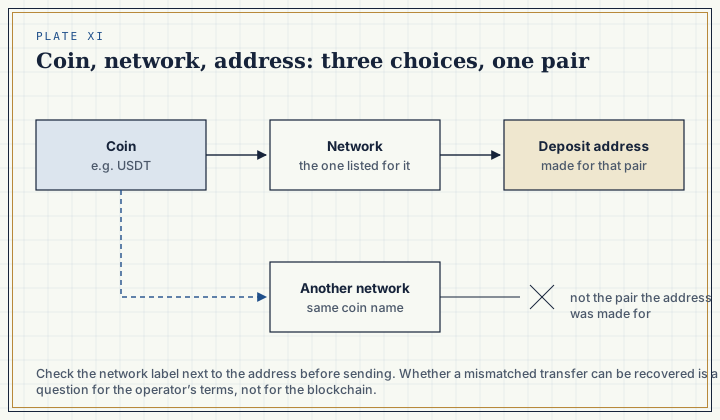
One coin can travel on more than one network. USDT exists on several chains, and tokens built on the Ethereum standard can sit on the main chain or on a second network that uses the same address format. The deposit page shows an address and, beside it, the network the casino watches for that address.
Before you send
- Open the cashier and choose the coin.
- Read the network name printed beside the address, not only the coin name.
- In your wallet, select exactly that network for the outgoing transfer.
- Copy the address with the copy button instead of retyping it.
- If the cashier shows a memo or tag field, fill it in.
- For a first deposit, send a small amount and wait until it is credited.
A transfer made on the wrong network, or sent below the stated minimum, can be lost. Blockchain transfers cannot be reversed by the sender, and a casino's cashier only credits what arrives in the form it expects. Some support desks make an effort to recover stray coins, but nothing on a deposit screen promises it.
Minimums per coin
Each coin carries its own minimum deposit, usually set in coin units rather than in dollars or euros. Rocketpot's 0.001 BTC is a clear case of that style. Bitcasino.io's terms (cl. 5) add a consequence: a deposit below the minimum for its coin is void, so it is not credited as an ordinary deposit.
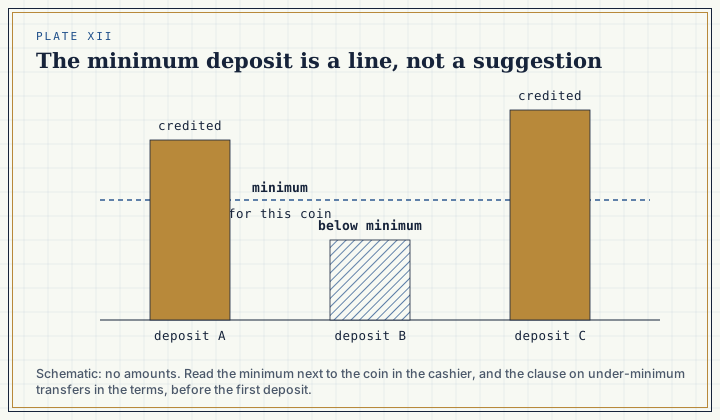
The arithmetic is short and easy to get wrong. When a minimum is fixed in coin units, its value in your home currency rises and falls with the price, so an amount that cleared the line last month may fall short today. The network fee also comes off before the coins land.
Take a made-up example: a cashier sets a minimum of 20 units of some coin and your wallet charges 0.4 units to send it. Sending exactly 20 delivers 19.6, which sits below the line. Sending 21 delivers 20.6 and clears it. Always compare the minimum with the amount that will arrive, not the amount that leaves.
Plinko crypto gambling and a balance that moves by itself
This is the part of plinko crypto gambling that feels least like a game. A session in a volatile coin has two sources of change: the bins under the board and the market outside it. A run of drops that land around 1× looks flat on screen, yet the same balance can be worth noticeably more or less in pounds, euros or dollars by the end of the evening.
Some cashiers show balances converted into a display currency, others show raw coin amounts. A display currency is only a view; the thing held is still the coin, unless the casino converts deposits into a stablecoin balance and says so. Stablecoins such as USDT track the dollar closely, which is one reason several limits in the ranking are written in USDT: Winz.io caps payouts at 100,000 USDT a week (cl. 11.7), while Bitcasino.io sets its weekly ceiling for large requests at 1 million USDT (cl. 6.10).
A sensible habit is to set your budget in the unit you actually think in. If you count in euros, a stablecoin removes one moving part. If you already hold Bitcoin and choose to play with it, accept that the bins are not the only thing deciding how the evening ends. Nothing about the coin changes the game's odds, which are laid out bin by bin on the page of probabilities for each row count.
A short checklist for plinko with crypto
Playing plinko with crypto adds these checks to the usual ones about the game itself:
- The coin is named in the cashier, not only in a banner.
- The network beside the address matches the one chosen in your wallet.
- The amount that will arrive, after the network fee, clears the per-coin minimum.
- You know which unit your budget is written in and how the balance is displayed.
- You have read the identity clause before the first large payout, as set out on the page about ID checks.
The route back out uses the same rules in reverse: pick the network the cashier offers for that coin, confirm your receiving wallet supports it, and paste the address instead of typing it. Caps per day, week or month then decide how much can leave at once; they are listed clause by clause on the page about caps and instalments.