One drop, start to finish
The Plinko gambling game explained from drop to payout bin
A ball leaves the top of the board, meets one peg on every row and settles in a bin with a number under it. Follow a single drop through the pegs, the paytable and your balance, with the sums shown.
This page shows how plinko works by following one ball from the moment you press the drop button to the moment your balance changes. Nothing below needs more than school arithmetic: count the pegs, count the routes, read the numbers printed under the bins. Once those three steps are clear, every board you meet in a casino lobby reads the same way.
How plinko works: the board in four parts
Think of the screen as a small machine with four components. Each one does a single job, and only one of them decides how much comes back.
- The stake. The amount you put on one drop, fixed before the ball is released.
- The pegs. A triangle of pins. The ball meets exactly one peg on each row on its way down.
- The bins. Slots along the bottom edge. A board with n rows has n + 1 bins, so 8 rows give 9 bins and 16 rows give 17.
- The paytable. A multiplier printed in each bin. What comes back from a drop is the stake multiplied by the number in the bin where the ball stops.
The idea is far older than any casino. In the nineteenth century the scientist Francis Galton built a wooden board of pins to show how many small random nudges pile up into a hump in the middle. The Plinko gambling game you open in a browser is software rather than wood and nails, but it borrows that same picture and adds a paytable underneath. Which lobbies actually carry that board is the subject of the bitcoin plinko sites ranking.
How plinko works on a single drop, row by row
Step 1: the stake leaves the balance
Pressing the button deducts the stake first. With a balance of US$50.00 and a stake of US$1.00, the display reads US$49.00 while the ball is still falling. The credit, if any, arrives only when the ball has settled.
Step 2: a left-or-right choice at every peg
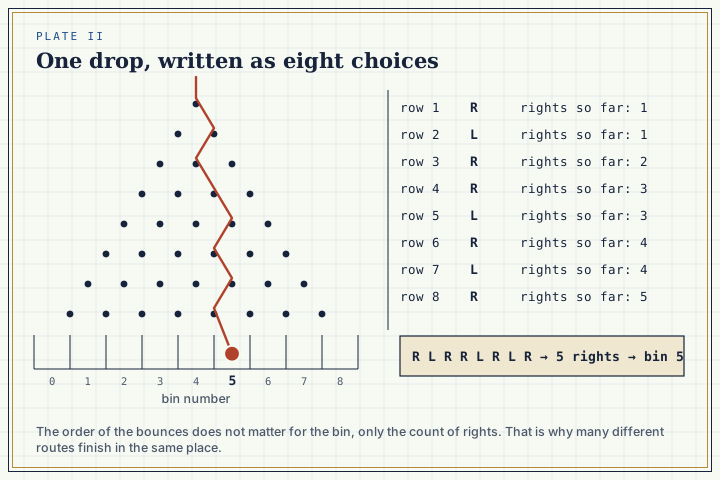
At each row the ball passes a peg on one side or the other. On a board where each peg splits evenly, both sides have a one-in-two chance. An 8-row board therefore asks eight such questions, and 2 multiplied by itself eight times gives 256 different routes from top to bottom.
In online versions, the software settles the outcome and the animation is drawn to match it. The bounces you watch are the display of a result, not the thing that produces it.
Step 3: the bin is just a count of right turns
This is the observation that makes the maths easy. Number the bins 0 to 8 from left to right. The ball ends in bin k when exactly k of its eight choices went right, whatever order they came in.
Only one route has no right turns at all, so the far-left bin is reached by 1 route of 256. The centre bin needs four rights and four lefts, and there are 70 different orders in which that can happen. That single fact explains why the middle of the board is always busy and the edges almost never are.
Step 4: the multiplier meets the stake
Take a made-up example. The ball stops in a bin printed 1.5× and the stake is US$1.00, so the game credits US$1.50 and the balance moves from US$49.00 to US$50.50.
Now suppose, in the same example, the bin reads 0.4×. The game credits US$0.40 and the balance ends at US$49.40. Something came back, yet the drop still lost 60 cents, because any multiplier below 1× returns only part of the stake.
Why the centre is crowded and the edges are rare
The number of routes into bin k on an n-row board is the binomial count C(n, k). For 8 rows the counts run 1, 8, 28, 56, 70, 56, 28, 8, 1, adding up to 256. The centre bin is reached 27.3% of the time and each edge bin 0.39%, roughly once in 256 drops.
Every Plinko gambling game built on evenly splitting pegs shares these counts, whoever drew the graphics. More rows stretch the gap. On 16 rows there are 65,536 routes; the centre takes 12,870 of them (19.6%) and each edge takes just one (0.0015%). The full set of numbers for 8, 12 and 16 rows sits on the bin-by-bin probability page. The effect of adding rows is worked through on the page about board height.
Paytables follow this shape for a simple reason. A large multiplier in a bin that fills a quarter of the time would hand back far more than the board takes in, so large numbers go where routes are scarce and small ones go where routes are plentiful.
The paytable, not the bounce, sets the return
Every paytable in a Plinko gambling game has a long-run return you can compute yourself: for each bin, multiply its probability by its multiplier, then add the results. Here is a made-up 8-row paytable, symmetrical from edge to centre, used only as an illustration.
- Example edge bins at 6×: 2 routes of 256 between them, adding 4.69 percentage points.
- Example next bins at 2×: 16 routes of 256, adding 12.50 points.
- Example third bins at 1.2×: 56 routes of 256, adding 26.25 points.
- Example fourth bins at 0.9×: 112 routes of 256, adding 39.38 points.
- Example centre bin at 0.5×: 70 routes of 256, adding 13.67 points.
The five lines total 96.48%, so this hypothetical table hands back about 96.5 cents per dollar staked over a very long run. Notice where that return comes from: the modest bins near the middle carry most of it, while the eye-catching edges supply less than five points. The multiplier page repeats the sum for a 16-row example.
The settings panel: rows, risk, bet amount, autoplay
Most boards put their controls in a panel beside the pegs, and once you know how plinko works the panel is quick to read. Each control changes something different, and it helps to know which part of the machine it touches.
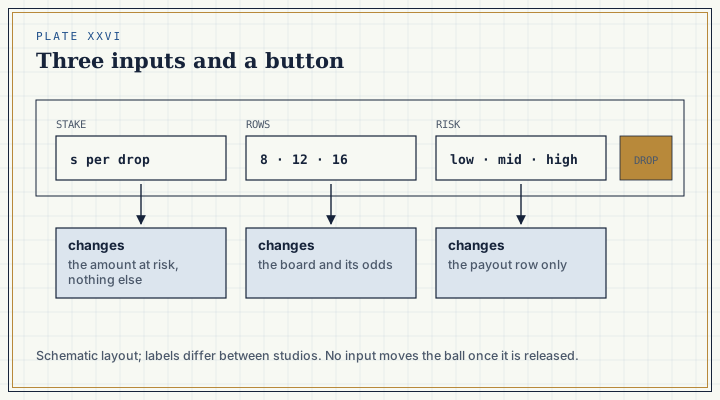
- Rows change the number of pegs, the number of bins and the routes into each bin.
- Risk swaps one printed paytable for another. The ball's route probabilities stay exactly as they were; only the numbers under the bins move. The risk setting page compares two made-up tables.
- Bet amount scales every credit up or down in proportion and changes nothing else.
- Autoplay repeats drops at the chosen settings, which raises how much is staked per hour. The autoplay article goes through that arithmetic.
None of these controls makes a bin more likely than the peg counts allow. No sequence of settings, and no app, can know which bin the next ball will reach.
Opening a Plinko game online: what the lobby tile shows
Finding a Plinko game online usually starts with a tile in a casino lobby. The tile carries the game's name and, when an outside studio made it, the studio's name; a version the casino built itself often shows no studio at all. Opening the tile of a Plinko game online loads the board, the settings panel and, on many versions, an information button.
That information screen is worth a minute before the first drop. It is where a studio prints the rows it offers, the names it gives its risk levels and the return figure it publishes, if it publishes one. What each studio prints is gathered on the page about who makes the game.
To play Plinko for real money, the account rules come first
Many boards offer a demo mode with play credits. It is a good place to watch how rows and risk move the paytable. If the demo shows the same rows, risk level and multipliers as the real-money board, the probabilities are the same too, because the pegs have no idea which balance is in use.
Deciding to play Plinko for real money moves the questions away from the board and onto the account. You register, accept the casino's terms, deposit in a coin its cashier lists, and at some point the terms may ask for identity documents. Each casino sets its own trigger for that check, its own deadlines and its own withdrawal caps. The page on identity checks covers those clauses. Deposit networks and minimums are on the crypto payments page.
Gambling is for adults aged 18 and over. Decide on a budget before the first drop and count whatever you stake as already spent. Anyone who finds the drops harder to put down than planned can look for a Gamblers Anonymous group, which meets in many countries.