How this guide works
About plinkogamblingsites and how its Plinko pages are put together
A guide to one game and the casinos that carry it, written from the casinos' own terms, the issuing authorities' registers and the studios' game pages, with a date beside every figure.
This page is about plinkogamblingsites itself: what the guide covers, which sources it trusts, how dates are shown and what happens when a fact goes stale. It is short on purpose, because the pages it describes are where the detail lives.
About plinkogamblingsites: what the pages cover
The guide has three layers. The first explains the game as a machine: pegs, rows, bins, the number of routes a ball can take, and how a risk setting swaps one paytable for another without touching the ball's path. Those numbers are arithmetic, labelled as such, and anyone can redo them with a calculator. The mechanics start on the walk-through of a single drop.
The second layer is the lobby check. A casino enters the numbered table only when its own lobby, or a game page on its own domain, showed Plinko on 16 September 2026. The titles recorded are the ones that lobby displayed, with the studio name as the lobby printed it. That lobby check is the gate behind the ranking gathered on the plinko gambling sites page.
The third layer is the account. Every numbered casino is scored on five things its terms put in writing: an identity clause, the moment that check starts, a sum, how long documents may take, and whether the issuing authority lists the licence against the casino's own domain. Bonus size, game count and caps are shown but never scored.
About plinkogamblingsites: where the facts come from
Only three kinds of source feed the pages:
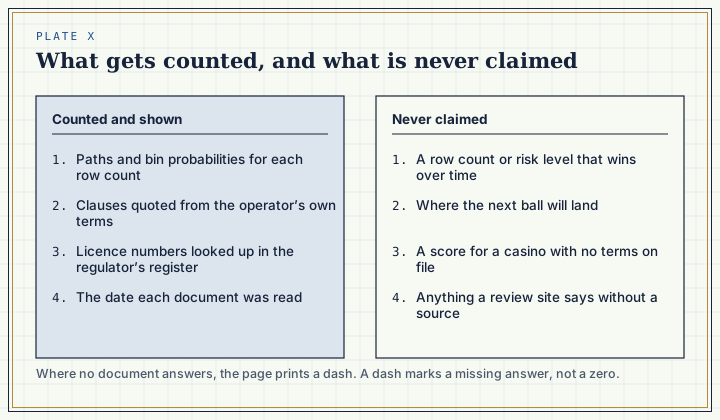
- Casinos' own pages. Terms and conditions, lobby tiles, game pages and promotions pages on the casino's own domain. A clause is quoted by its number, such as Rocketpot's cl. 11.5 on instalments.
- Registers. The certificate portal at cert.cga.cw for Curaçao, the Anjouan register and the Tobique holder list. A lookup records the holder, the status, the dates and the domains exactly as they read.
- Studios' game pages. What Spribe, BGaming, Hacksaw Gaming and others print about their own Plinko, such as a return figure, risk-level names, a row range or a top multiplier. Where a studio prints nothing, the field reads «—» and no estimate is filled in.
Review portals, forums and aggregator lists are not used as evidence for any fact on these pages. If a claim cannot be traced to one of the three sources above, it does not appear.
A date on every figure
Terms get rewritten, registers get updated and lobbies rotate their tiles, so a figure without a date is hard to trust. Every clause, lookup and studio figure on the site carries the day it was read, for example «read 16 September 2026» for BGaming's page or «12 September 2026» for a certificate search. When two sources disagree, as Bitcasino.io's page and Spribe's page do on the return figure for the same title, both are kept with their own dates.
The header of each page shows when that page was last updated, which is a separate thing from the dates inside it.
Two accounts used with real money
Only two casino accounts were used with the editors' own money. At Vave, on 28 August 2026, deposits and withdrawals met no ID request until the withdrawals reached about 5,000 USDT in total. At TrustDice, in May 2026, USDT withdrawals went out with no questions asked until their sum crossed roughly US$5,000; a compliance review came next, and the passport that finally cleared it was the fifth attempt. Both are observations about one account each, reported next to the terms rather than in place of them.
Corrections
A cell is only as good as its last reading. When a casino changes a clause, a register entry moves, or a studio edits its game page, the affected cell is re-read, the new wording and clause number replace the old, and the date changes with them. If the new text adds or removes one of the five items, the score moves accordingly on the ranking page.
Nothing is kept on the page after it has stopped matching its source. A figure that can no longer be found is removed, and the cell returns to «—» until a fresh reading supplies a value.