Chances, bin by bin
Plinko winning odds for 8, 12 and 16 rows, computed bin by bin
Every bin on an evenly split board has a chance you can compute from route counts alone. The lists below give them for three board heights, along with the limits of what a percentage can tell you about one drop.
Plinko winning odds, in the sense people search for them, are really the chances of the ball reaching each bin. Those chances come from counting routes through the pegs, so they can be written down exactly for any board height. This page lists them for 8, 12 and 16 rows, turns percentages into one-in-N figures, and then shows how a paytable decides which of those bins count as a win.
| Board | Edge bin | 2nd from edge | 3rd from edge | 4th from edge | 5th from edge | 6th from edge | 7th from edge | 8th from edge | Centre |
|---|---|---|---|---|---|---|---|---|---|
| 8 rows 9 bins, 256 paths | 0.39% | 3.1% | 10.9% | 21.9% | 27.3% | ||||
| 12 rows 13 bins, 4,096 paths | 0.02% | 0.29% | 1.6% | 5.4% | 12.1% | 19.3% | 22.6% | ||
| 16 rows 17 bins, 65,536 paths | 0.0015% | 0.02% | 0.18% | 0.85% | 2.8% | 6.7% | 12.2% | 17.5% | 19.6% |
Where every probability on the board comes from
On a board where each peg sends the ball left or right with equal chance, a board of n rows has 2ⁿ equally likely routes. The ball ends in bin k, counting from the left edge as bin 0, when exactly k of its n turns went right. The number of routes into bin k is C(n, k), the number of ways to choose k items from n. These are odds for the board itself, separate from which casinos even carry it, a question the bitcoin plinko sites ranking answers instead.
The probability of bin k is therefore C(n, k) divided by 2ⁿ. Nothing else enters the formula: not the stake, not the risk level, not the colour of the ball, and not what happened on the previous drop. The walk-through of a single drop shows why the bin is simply a count of right turns.
Plinko winning odds for 8, 12 and 16 rows
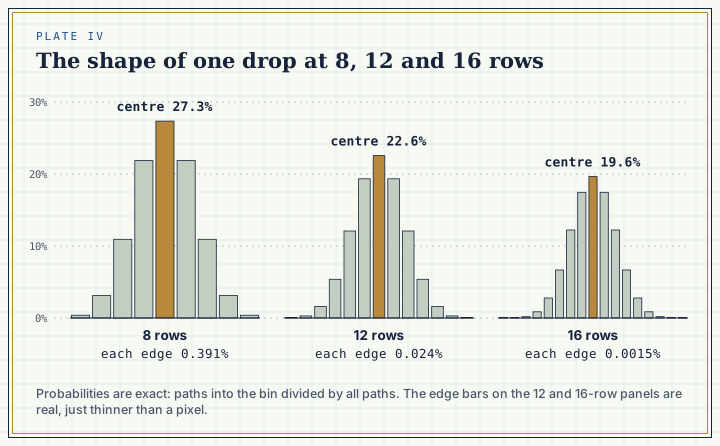
The figure above sets all three heights side by side. The same numbers are written out here, from each edge towards the centre; the other half of the board repeats them in reverse.
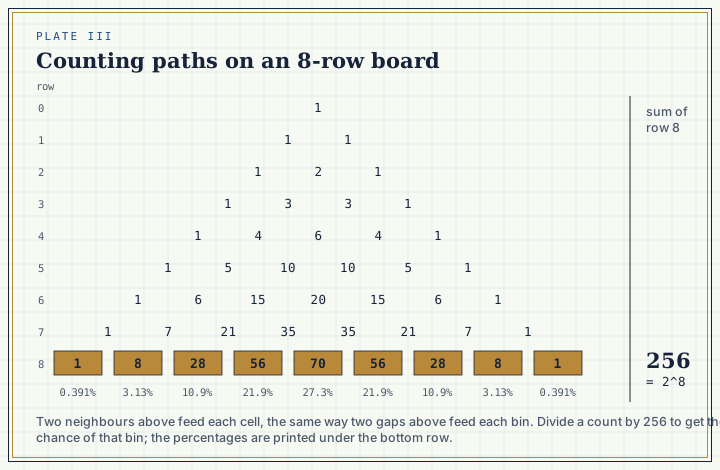
8 rows, 256 routes
- Edge bin: 1 route, 0.39%, about 1 in 256.
- Next bin in: 8 routes, 3.13%, about 1 in 32.
- Third bin: 28 routes, 10.94%, about 1 in 9.
- Fourth bin: 56 routes, 21.88%, about 1 in 4.6.
- Centre bin: 70 routes, 27.34%, about 1 in 3.7.
12 rows, 4,096 routes
- Edge bin: 1 route, 0.024%, 1 in 4,096.
- Second: 12 routes, 0.29%, about 1 in 341.
- Third: 66 routes, 1.61%, about 1 in 62.
- Fourth: 220 routes, 5.37%, about 1 in 19.
- Fifth: 495 routes, 12.08%, about 1 in 8.3.
- Sixth: 792 routes, 19.34%, about 1 in 5.2.
- Centre: 924 routes, 22.56%, about 1 in 4.4.
16 rows, 65,536 routes
- Edge bin: 1 route, 0.0015%, 1 in 65,536.
- Second: 16 routes, 0.024%, 1 in 4,096.
- Third: 120 routes, 0.18%, about 1 in 546.
- Fourth: 560 routes, 0.85%, about 1 in 117.
- Fifth: 1,820 routes, 2.78%, about 1 in 36.
- Sixth: 4,368 routes, 6.67%, 1 in 15.
- Seventh: 8,008 routes, 12.22%, about 1 in 8.2.
- Eighth: 11,440 routes, 17.46%, about 1 in 5.7.
- Centre: 12,870 routes, 19.64%, about 1 in 5.1.
The page on board height explains why the centre share falls and the edges fade as rows are added.
Checking a count by hand
Any route count on this page can be checked with a pocket calculator. C(n, k) is n multiplied down k times, divided by k factorial. For the fifth bin from the edge on 16 rows, k is 4:
- Top: 16 × 15 × 14 × 13 = 43,680.
- Bottom: 4 × 3 × 2 × 1 = 24.
- Divide: 43,680 ÷ 24 = 1,820 routes.
Then divide by the total number of routes, 65,536, and the result is 0.0278, or 2.78%. A quick sanity check is that the counts for one height always add up to 2ⁿ, and that the list reads the same from either edge.
What counts as a win depends on the paytable
A bin is only a win if its printed multiplier is above 1×. The route counts cannot tell you that; the paytable can. So the chance of a winning drop is the sum of the probabilities of every bin printed above 1×.
Take a made-up 8-row paytable that reads 6×, 2×, 1.2×, 0.9× and 0.5× from edge to centre. The bins above 1× are the outer three on each side, holding 2 + 16 + 56 = 74 routes of 256. In this example, 28.9% of drops come back larger than the stake and 71.1% come back smaller.
Now swap in a second made-up table for the same height: 26×, 4×, 1.5×, 0.3× and 0.2×. The same outer six bins sit above 1×, so the chance of a winning drop in this example is still 28.9%. What changed is the size of those wins and the size of the losses in between, which is the subject of the risk settings page.
A 16-row example shows a third pattern. Suppose a hypothetical table prints values above 1× on the outer six bins of each side, exactly 1× on the seventh and below 1× on the three central bins. The chances split into 21.0% above the stake, 24.4% returning it unchanged and 54.5% below it.
One-in-N is not a schedule
A figure like 1 in 256 describes a long run, not a queue. Every drop starts afresh, and the ball has no memory of the drops before it. An edge bin that has not appeared for 500 drops on an 8-row board is exactly as likely on drop 501 as it was on drop one.
The arithmetic shows how loose the link between one-in-N and experience is. On 8 rows, the chance of reaching a particular edge at least once in 256 drops is only about 63.3%. The chance of reaching neither edge in 256 drops, even though you would expect two visits on average, is about 13.4%.
This is why no app or pattern-watcher can say which bin comes next. The chances above are all there is to know, and they reset on every drop.
From plinko winning odds to expected return
Probabilities become money only through the paytable. The long-run return of a board is each bin's probability multiplied by its multiplier, summed over all bins. For the first made-up 8-row table above, that sum is 96.48%, meaning this example table hands back about 96.5 cents per dollar over a very long run. The multiplier page works the same sum for 16 rows.
Read that way, plinko winning odds describe how often each outcome turns up, while the return describes what those outcomes are worth on average. Neither promises anything about a session of a few hundred drops, and neither can be changed by choosing when to press the button.
Using these numbers sensibly
The practical value of the table is expectation-setting. Before choosing a height and a risk level, look at how rare the bins with large printed values are, then ask how many drops your budget covers. If the budget covers 300 drops at 16 rows, the edges are, for practical purposes, decoration.
Gambling is for adults aged 18 and over. Decide on a budget in advance and stop when it is used, whichever bins the ball happened to find.