Scoring, step by step
How the plinko site ranking method scores a casino's own rules
One lobby check decides whether a casino enters the table; five written rules from its own terms decide how many points it gets. Each step below comes with a real row as the example.
The plinko site ranking method is deliberately narrow. It does not try to say which casino is most fun or has the nicest board; it asks whether a casino's own terms answer five practical questions about identity checks and licensing, and it gives one point per answer found in writing.
The lobby gate in the plinko site ranking method
Before any scoring, a casino has to clear one gate. A number is given only where the casino's own lobby, or a game page on its domain, displayed Plinko on 16 September 2026, and where there were terms solid enough to score. A tile seen in a third-party review, a press release or a sitemap line does not count. The casinos that clear this gate end up together on the plinko casinos page, scored side by side.
For each casino that passes, the table keeps the Plinko titles the lobby displayed and the studio name exactly as the lobby printed it. Where a tile names no outside maker, as with Rocketpot's Plinko under its Exclusive games heading or Rainbet's under Rainbet Originals, the board is treated as a house version. Which makers stand behind the studio builds is covered on the page about who builds each board.
Casinos with Plinko in the lobby but outside the numbered rows stay further down without a score.
The five checks in the plinko site ranking method
Each check is a yes or a no. A yes needs a clause the reader can find; a vague sentence in a help article or a support chat reply is not enough.
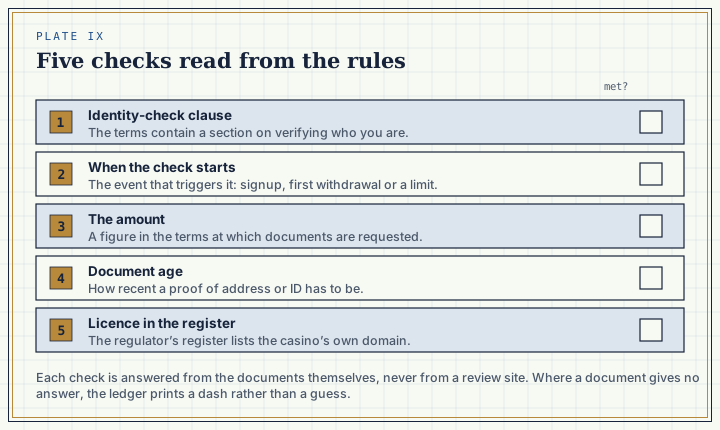
1. Is there an identity clause?
The first point goes to any casino whose terms say, in so many words, that it may ask for proof of identity. Bitsler shows how low this bar sits: cl. 8.22 and cl. 4.3 cover identity, and that alone earns the point even though the same clauses leave every other question open. Every one of the twelve numbered casinos clears this check.
2. Does the clause say when checking starts?
A clause that says «we may ask at any time» tells you little. The second point needs a named moment. Rocketpot links its check to a withdrawal request (cl. 11.4, 12.4). Bitcasino.io names a trigger event instead (cl. 3.13, 6.6), which counts just as well. Bitsler's wording names no moment, so it does not.
3. Is there a sum?
A sum lets you estimate how far an account can go before documents come up. Bitcasino.io writes €2,500 or its value in coins into its terms. Rocketpot's figures are split across two clauses, one naming US$2,000 and the other US$2,500. Winz.io, Metaspins and Rainbet print no figure, and each loses this point.
4. Is there a deadline for documents?
Once a check starts, a written deadline tells you how long you have to respond. Rainbet's cl. 20.1 gives 72 hours, Metaspins' cl. 9.10 gives 30 days and Rocketpot's cl. 12.2 gives 30 calendar days. Vave allows 14 days under cl. 8.7. Bitcasino.io, Sportsbet.io and Shuffle.com set no deadline, and each misses the point.
5. Does the register list the licence under the casino's domain?
The last point is earned outside the casino's own pages. The licence has to show in the issuing authority's register, and the entry has to carry the casino's own domain. Sportsbet.io passes: a cert.cga.cw lookup for sportsbet.io on 16 September 2026 returned OGL/2023/110/0072 as active. Vave does not, because the certificate for Latcas B.V. carried vavegame.com in its domain field on 12 September 2026 and not vave.com. The licence page explains why the domain matters as much as the number.
What counts as evidence
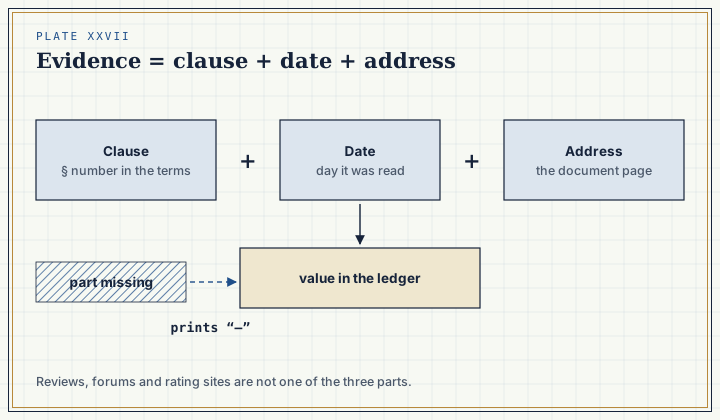
Every yes rests on three things kept together: the clause number, the date the page was read and the address it was read from. A cell that says «At withdrawal» for Rocketpot, for instance, stands on cl. 11.4 and 12.4 of the terms at rocketpot.io, read on a stated date. Without all three, a claim cannot be rechecked, and a claim that cannot be rechecked does not score.
Lobby evidence follows the same rule. For Blockbet the table holds the game page address for Plinko X Classic, the maker as that page prints it and the date, 16 September 2026. When a casino's page and a studio's page print different figures for the same game, both are kept with their sources, and neither overwrites the other.
How register lookups work
For Curaçao certificates the lookup runs on cert.cga.cw, the portal of the issuing authority. A search by domain or by certificate number returns the holder, a status, the issue date and a list of domains. Moon Technologies B.V., for example, holds OGL/2023/111/0069 for Bitcasino.io, and the domain list included bitcasino.io on 12 September 2026.
For Anjouan the lookup runs on that authority's public register, which lists a holder, a licence number, an expiry date and domains. Blockbet's entry, read on 16 September 2026, listed blockbet.gg against ALSI-202603013-FI1, the same number its footer prints. Some holder lists carry no domains at all: the Tobique list names GG Gaming S.R. L as a holder to 8 May 2027 but gives no website, so Winna cannot be matched and gets no fifth point.
A lookup that returns «not valid», as happened twice for Rocketpot's 1668/JAZ on 12 and 13 September 2026, is recorded as it reads. So is an expiry date that has passed while the status still reads valid, which is what Hyper Lucky's Anjouan entry showed on 16 September 2026.
What the score leaves out
Several things readers care about are shown in the table but never scored:
- Game count and studio mix. A lobby with three Plinko versions scores the same as one with a single board.
- Bonus size. A 150% match is not worth a point; the wagering clause behind it may matter more, and the notes on caps and wagering cover it.
- Withdrawal caps. Winz.io's 100,000 USDT a week (cl. 11.7) and Winna's US$10,000 per 24 hours (cl. 8.7) are shown in the cells but carry no weight in the score.
- How quickly money moves. No timing is recorded or scored.
- Return figures. A studio's printed RTP describes its game, not the casino's account rules.
Vave sits in the first row of the table without a number, and the numbered rows start below it.
The two real-money tests
Two accounts were used with real deposits. Vave came first: the editors deposited their own funds on 28 August 2026, and the withdrawals that followed met no identity request until they totalled about 5,000 USDT. TrustDice came second, where through several weeks of May 2026 the editors deposited USDT; once the withdrawal total passed about US$5,000, a request sat at «payment under review» until compliance wrote with a Veriff link, the driving licence sent first got refused, the passport went through at the fifth go, and a fresh email request for documents came later still.
Neither account changes a score. A test describes one account in one period, while the score reads what the terms allow for everyone, and Vave's cl. 8.7 leaves room for documents to be demanded ahead of any payout.
Empty cells and corrections
When a field has nothing to show, the table prints «—» and the text leaves it out. Sportsbet.io's withdrawal-cap cell and Shuffle.com's coin cell both read that way. A dash costs nothing by itself: only the five checks move the score.
Terms change, and clause numbers move. When a re-read finds different wording, the cell, the clause number and the date are updated together, and the score follows whatever the new text says. How the pages are put together is described on the page about this guide.