Board maths and lobby checks
Best Plinko gambling sites ranked by their account rules
Casinos whose own lobby showed a Plinko board on 16 September 2026, scored on five account rules from their terms, alongside the path counts, paytables and seed checks behind every drop.
Top of the ledger
| Rank | Casino | Plinko in the lobby | Licence | Coins | Identity check | Withdrawal cap | Checks met | Open |
|---|---|---|---|---|---|---|---|---|
| Vave | — | Curaçao · certificate lists vavegame.com register, 12 Sep 2026 | — | At withdrawal cl. 8.7 | No cap per period (cl. 8.8) | 3 of 5 | Visit the casino | |
| 1 | Bitcasino.io | Plinko · Spribe; PLINKO · house version own lobby, 16 Sep 2026 | Curaçao · register: active register, 12 Sep 2026 | 12–13 on the list | On a trigger event cl. 3.13, 6.6 | Up to 1 million USDT a week (cl. 6.10) | 4 of 5 | Visit the casino |
| 2 | Rocketpot | Plinko · house version own lobby, 16 Sep 2026 | Curaçao · portal: not valid register, 13 Sep 2026 | 13 on the list | At withdrawal cl. 11.4, 12.4 | US$5,000 a month after a large win (cl. 11.5) | 4 of 5 | Visit the casino |
| 3 | Sportsbet.io | PLINKO · house version; Plinko · BGaming own lobby, 16 Sep 2026 | Curaçao · register: active register, 16 Sep 2026 | 5 named, list left open | At withdrawal cl. 6.5, 6.6 | — | 4 of 5 | Visit the casino |
Every button in this ledger opens the same place: the casino this site is paid to feature, and not the operator printed in the row beside it. The rows themselves are scored on what each operator publishes — the licence entry, the coin list, the identity clause and the withdrawal cap — and that scoring is not for sale.
Plinko gambling sites differ far less in the board than in the account wrapped around it. The ball drops through much the same triangle of pegs everywhere; what changes between casinos is who built the game, when an identity check starts, how much may leave in a week and which register carries the licence.
This page does two jobs. It ranks Plinko gambling sites that had the game in their own lobby on 16 September 2026, scoring each on rules printed in its terms, and it explains the board with numbers you can redo on paper in a few minutes.
| Rank | Casino | Plinko in the lobby | Licence | Coins | Identity check | Withdrawal cap | Checks met | Open |
|---|---|---|---|---|---|---|---|---|
| Vave | — | Curaçao · certificate lists vavegame.com register, 12 Sep 2026 | — | At withdrawal cl. 8.7 | No cap per period (cl. 8.8) | 3 of 5 | Visit the casino | |
| 1 | Bitcasino.io | Plinko · Spribe; PLINKO · house version own lobby, 16 Sep 2026 | Curaçao · register: active register, 12 Sep 2026 | 12–13 on the list | On a trigger event cl. 3.13, 6.6 | Up to 1 million USDT a week (cl. 6.10) | 4 of 5 | Visit the casino |
| 2 | Rocketpot | Plinko · house version own lobby, 16 Sep 2026 | Curaçao · portal: not valid register, 13 Sep 2026 | 13 on the list | At withdrawal cl. 11.4, 12.4 | US$5,000 a month after a large win (cl. 11.5) | 4 of 5 | Visit the casino |
| 3 | Sportsbet.io | PLINKO · house version; Plinko · BGaming own lobby, 16 Sep 2026 | Curaçao · register: active register, 16 Sep 2026 | 5 named, list left open | At withdrawal cl. 6.5, 6.6 | — | 4 of 5 | Visit the casino |
| 4 | Winz.io | Plinko · Spribe; Plinko · BGaming; PlinkoX · house version own lobby, 16 Sep 2026 | Anjouan and Tobique register, 24 Aug 2027 | 12 on the list | At withdrawal cl. 8.4, 11.10 | 100,000 USDT a week · 400,000 USDT a month (cl. 11.7) | 4 of 5 | Visit the casino |
| 5 | Blockbet | Plinko X Classic · SmartSoft; Plinko · house version own lobby, 16 Sep 2026 | Anjouan · valid until 13 March 2027 register, 16 Sep 2026 | — | At withdrawal cl. 8.3; KYC Policy | €10,000 a month; €5,000 when the balance is ten times the deposits (cl. 8.6) | 4 of 5 | Visit the casino |
| 6 | Metaspins | Plinko · house version; Plinko · Spribe own lobby, 16 Sep 2026 | Anjouan in the terms, Curaçao in the register register, 12 Sep 2026 | — | On a trigger event cl. 9.7 | No upper cap; large sums in instalments (cl. 12.5) | 3 of 5 | Visit the casino |
| 7 | Rainbet | Plinko · house version own lobby, 16 Sep 2026 | No licence number published register | 9 named, list left open | At withdrawal cl. 20.1 | No upper cap; US$15 minimum (cl. 8.1) | 3 of 5 | Visit the casino |
| 8 | Shuffle.com | Plinko · house version; Plinko · Hacksaw Gaming own lobby, 16 Sep 2026 | Curaçao · register: active register, 8 Sep 2026 | — | On a trigger event cl. 5.2 | — | 3 of 5 | Visit the casino |
| 9 | TG.Casino | PLINKO · house version; Plinko · BGaming own lobby, 16 Sep 2026 | No licence number published register, 16 Sep 2026 | — | At withdrawal cl. 9.3 | €150,000 per rolling 30 days (cl. 9.6) | 3 of 5 | Visit the casino |
| 10 | Winna | Plinko · house version own lobby, 16 Sep 2026 | Tobique · holder list without domains register, 8 May 2027 | 10 named, list left open | On a trigger event cl. 6.1, 6.2, 8.5 | US$10,000 per 24 hours (cl. 8.7) | 3 of 5 | Visit the casino |
| 11 | Hyper Lucky | Plinko · TaDa Gaming own lobby, 16 Sep 2026 | Anjouan · expiry date passed register, 28 Aug 2026 | — | On a trigger event cl. 10.3, 8.13 | — | 3 of 5 | Visit the casino |
| 12 | Bitsler | Plinko · house version; Plinko · BGaming; Plinko · Hacksaw Gaming own lobby, 16 Sep 2026 | Curaçao · register: active register, 12 Sep 2026 | — | On a trigger event cl. 8.22, 4.3 | Operator sets the minimum and maximum (cl. 8.6) | 2 of 5 | Visit the casino |
Every button in this ledger opens the same place: the casino this site is paid to feature, and not the operator printed in the row beside it. The rows themselves are scored on what each operator publishes — the licence entry, the coin list, the identity clause and the withdrawal cap — and that scoring is not for sale.
More casinos in the list, without a score
- Thunderpick
- BetFury
- WinDice
- Wolfbet
- Coins.Game
- TrustDice
- Wild Fortune
- Jack.com
- Wild.io
How the ranking of Plinko gambling sites works
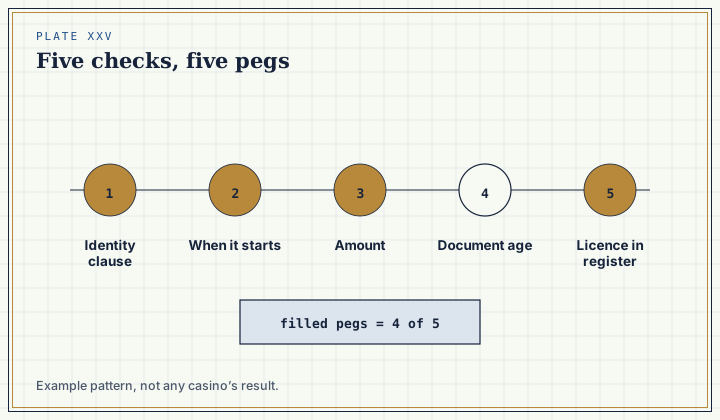
Each casino earns one point for every item below that its terms put in writing:
- a clause about checking identity;
- the moment that check begins, such as a withdrawal request or a trigger event;
- a sum written into the clause;
- a deadline for sending documents;
- the licence appearing in the issuing authority's register under the casino's own domain.
A casino gets a number only if a Plinko tile turned up in its lobby, or on a game page on its own domain, on 16 September 2026, and if its terms could be scored. Catalogue size, bonus size and the pace of payments stay outside the score, so a huge game count earns nothing here.
That turns the list of best plinko gambling sites into a reading of paperwork rather than a verdict on entertainment. Among Plinko gambling sites in this table, four points means four of the five items were found in writing; the missing one is simply left open by the terms. Every check, with a worked example, is laid out on the page describing the scoring.
Twelve Plinko gambling sites in ranking order
Vave sits in the first row of the table without a number. The twelve Plinko gambling sites below follow the table's order, points are out of five, and every clause number refers to that casino's own terms.
1. Bitcasino.io
Bitcasino.io showed two boards: Spribe's Plinko on its studio page and a house version titled PLINKO in the Bitcasino Originals row. The licence cell reads Curaçao, register active: Moon Technologies B.V. is the holder of OGL/2023/111/0069 (dated 1 July 2024), and bitcasino.io turned up in that certificate's domain list during a 12 September 2026 search. Identity checks start on a trigger event (cl. 3.13, 6.6), with a threshold of €2,500 or its value in coins. No deadline for documents is printed, which is where the fifth point went. Large requests may reach 1 million USDT a week (cl. 6.10). Its coin list holds 12–13 entries, each coin has its own minimum, and a deposit below that minimum is void (cl. 5). It suits someone who wants a studio board and a house board side by side under a high weekly ceiling. Score: 4/5.
2. Rocketpot
Rocketpot has one Plinko, released 13 August 2025 under its Exclusive games heading with no outside studio named, so it counts as a house version. Its terms (cl. 1.2) cite licence 1668/JAZ, and two portal lookups on cert.cga.cw, on 12 and 13 September 2026, returned that certificate as not valid, so the register point is missing. Everything else is in writing. The ID check begins at withdrawal (cl. 11.4, 12.4), and two clauses set thresholds of US$2,000 and US$2,500. The deadline for documents is 30 calendar days (cl. 12.2). Once a large win is involved, sums from US$5,000 leave in instalments of at most US$5,000 a month (cl. 11.5). The minimum deposit is 0.001 BTC (cl. 10.2) and 13 coins are listed. It suits a reader who wants each identity step spelled out and can live with a monthly instalment ceiling. Score: 4/5.
3. Sportsbet.io
Sportsbet.io runs two boards: a house PLINKO in its originals row, whose game page states there is no fun mode, and BGaming's Plinko among the casual games. MBet Solutions N.V. (company no. 129230) holds OGL/2023/110/0072, granted 22 July 2024; the cert.cga.cw lookup for sportsbet.io on 16 September 2026 returned it as active, and cl. 1.2 of the terms prints the same number. The identity check is tied to withdrawal (cl. 6.5, 6.6) and the clause carries a sum. Nothing in the terms sets a deadline for documents, and that is the lost point. Five coins are named, with the list left open. It suits someone who wants BGaming's version, which its maker lists at 99% RTP, next to a board the casino built itself. Score: 4/5.
4. Winz.io
Winz.io has the widest spread of makers: Spribe's Plinko, BGaming's Plinko and a PlinkoX tile with no studio name printed beside it. In the Anjouan register, which showed winz.io on 16 September 2026, the holder is Novatrix SRL and the number ALSI-202508056-FI2 runs to 24 August 2027; the terms (cl. 1.1) also cite Tobique licence no. 0000002, whose holder list gives company names only. The check begins at withdrawal (cl. 8.4, 11.10) and a deadline for documents is set, but no sum is printed, so the score stops at four. Withdrawals are capped at 100,000 USDT a week and 400,000 USDT a month (cl. 11.7). Clause 4.1 lists 12 coins. It suits a reader who likes to compare boards from different makers without leaving one lobby. Score: 4/5.
5. Blockbet
Blockbet's lobby carries SmartSoft's Plinko X Classic and a Blockbet Originals Plinko. For the SmartSoft title the casino's game page shows a 3.00% house edge and 97.00% RTP, while SmartSoft's own page gives no return figure at all, so that number is the casino's. 3-102-953229 SRL holds Anjouan licence ALSI-202603013-FI1, issued 14 March 2026 and valid until 13 March 2027; on 16 September 2026 the register entry listed blockbet.gg, and the footer prints the same number. The check starts at withdrawal (cl. 8.3 and the KYC Policy) with a sum written in, though no deadline for documents appears. Monthly withdrawals top out at €10,000, and that ceiling halves to €5,000 once a balance stands at ten times what was deposited (cl. 8.6). It suits someone who already plays SmartSoft games and reads cap clauses line by line. Score: 4/5.
6. Metaspins
Metaspins shows a house Plinko under its ORIGINALS label and Spribe's Plinko. The licence cell reads Anjouan in the terms, Curaçao in the register: cl. 1.1 prints ALSI-202606048-FI2, whereas a Curaçao lookup on 12 September 2026 found OGL/2024/1063/0437 held by Metaspins N.V. and active for metaspins.com. The table records both and does not choose between them. The identity check starts on a trigger event (cl. 9.7) and documents are due in 30 days (cl. 9.10), but no sum is printed. There is no upper withdrawal cap, and large sums may be split into instalments (cl. 12.5). It suits a reader who is comfortable weighing two licence records for one brand before signing up. Score: 3/5.
7. Rainbet
Rainbet's single board is a house Plinko, listed first among the Rainbet Originals in its menu. The footer seal shows no licence number, and cl. 21.6 names Gaming Services Provider N.V. as the authority, so no register entry can be matched to the domain. Identity checks are attached to withdrawal (cl. 20.1). That same clause allows 72 hours to send documents. No sum is written in. The terms set no upper cap on withdrawals and a US$15 minimum (cl. 8.1). Nine coins are named and the list stays open. It suits someone who values a short, plainly stated document deadline and is happy with one house board. Score: 3/5.
8. Shuffle.com
Shuffle.com runs a house Plinko among its originals and Hacksaw Gaming's Plinko on a separate game page. Natural Nine B.V. is the named holder of OGL/2024/1337/0628, dated 16 October 2024, and a register search made on 8 September 2026 found it active for shuffle.com. The identity clause (cl. 5.2) starts on a trigger event, yet it prints neither a sum nor a deadline, which holds the score at three. Because Hacksaw prints seven RTP figures for this game, ranging between 88.20% and 98.98%, it pays to find out which build the lobby carries before a first drop. It suits a reader who wants Hacksaw's board and accepts open-ended wording on checks. Score: 3/5.
9. TG.Casino
TG.Casino offers a house PLINKO and BGaming's Plinko, the latter with a demo page. No licence number appears: cl. 22.6 sends complaints to Gaming Services Provider N.V., and typing tg.casino into the cert.cga.cw portal on 16 September 2026 brought up nothing. The identity check starts at withdrawal (cl. 9.3) and names a sum, while the terms give no deadline for documents. Withdrawals are capped at €150,000 per rolling 30 days (cl. 9.6). BGaming prints a top multiplier of 1,000× for its version and names three risk levels: high, normal and low. It suits someone who wants a studio board whose maker prints its settings, plus a large rolling cap. Score: 3/5.
10. Winna
Winna's board is a house Plinko under the Winna Originals label. The terms and a help article name GG Gaming S.R. L. under the Tobique authority (TGC) without a number; the TGC holder list, opened 16 September 2026, shows GG Gaming S.R. L as a B2C holder to 8 May 2027 but prints no domains, so winna.com cannot be matched to it. Identity checks start on a trigger event (cl. 6.1, 6.2, 8.5) and the clause states a sum; a deadline for documents is absent. The withdrawal cap is US$10,000 per 24 hours (cl. 8.7). Ten coins are named and the list is left open. It suits a reader who plays modest amounts and wants a daily ceiling written down. Score: 3/5.
11. Hyper Lucky
Hyper Lucky's lobby holds one board, Plinko by TaDa Gaming, which asks you to sign in before it opens. The terms name Brightsky Limited and ALSI-202508057-FI2. Its Anjouan register entry, opened 16 September 2026, carries hyperlucky.com and that number under the name BrightSky Ltd, yet the expiry date shown is 28 August 2026, already past, while the status still reads valid. Checks begin on a trigger event (cl. 10.3, 8.13) with a sum in the clause, and no deadline for documents is set. TaDa Gaming prints no return figure, row range or top multiplier for this Plinko, so those fields show «—». It suits a reader who already knows TaDa's games and will look at the register entry before depositing. Score: 3/5.
12. Bitsler
Bitsler has three boards: its own Plinko, whose page mentions 8 to 16 rows and risk from low to high, BGaming's Plinko and Hacksaw Gaming's Plinko. Oyine N.V. holds OGL/2024/930/0387, issued 22 July 2024, and bitsler.com sat on it at the 12 September 2026 lookup, although the terms still speak of an application. An identity clause exists (cl. 8.22, 4.3), yet it names no starting moment, no sum and no deadline, which leaves two points. On withdrawals, cl. 8.6 lets the operator set the minimum and maximum instead of printing figures. It suits someone who wants the most versions of the board in one place and is ready for loose wording on checks. Score: 2/5.
More casinos stand further down the table without a score.
Plinko in five minutes
The board is a triangle of pegs. A ball enters at the top, meets one peg per row and goes left or right; after the last row it falls into one of the bins along the bottom. A board with n rows has n + 1 bins, so 8 rows give 9 bins and 16 rows give 17.
If each peg splits the ball evenly, a drop is a string of n left-or-right choices. That gives 2ⁿ possible routes, all equally likely, and the number of routes ending in bin k is the binomial coefficient C(n, k). The geometry applies to any board on Plinko gambling sites, whoever built it, and what follows is plain arithmetic rather than a figure from a studio:
- 8 rows: 256 routes, spread 1, 8, 28, 56, 70, 56, 28, 8, 1 across the bins. The centre bin collects 70 of them, about 27.3%, and each edge bin collects 1, about 0.39%.
- 12 rows: 4,096 routes. The centre takes 924 (22.6%); an edge takes 1 (0.024%).
- 16 rows: 65,536 routes. The centre takes 12,870 (19.6%); an edge takes 1 (0.0015%).
Adding rows spreads the ball across more bins and makes the edges far rarer. A risk setting does something else entirely: it leaves the path of the ball untouched and swaps the paytable printed under the bins. Lower settings keep the multipliers bunched together, while higher ones push value towards the edges and pay less than the stake near the middle.
Working out a paytable's return
Expected return is the sum, over all bins, of the bin's probability times its multiplier. Here is a made-up 8-row example that belongs to no studio: 6× on each edge, 2× on the next pair, 1.1× on the pair after that, 1× beside the centre and 0.5× in the centre bin.
In this hypothetical table, weighting each multiplier by its route count gives (2 × 6 + 16 × 2 + 56 × 1.1 + 112 × 1 + 70 × 0.5) ÷ 256 = 252.6 ÷ 256, roughly 0.987. Over a very long run this example board hands back about 98.7% of what is wagered, whatever order the bins arrive in. The drop itself, the settings panel and demo play are walked through on the guide to pegs, rows and payout bins.
What a studio prints about its board
On Plinko gambling sites the same title often appears under several makers, and the makers' game pages vary a lot in how much they say. Each line below comes from the maker's game page, read 16 September 2026:
- Spribe prints an RTP of 97% and nothing else about the board: no risk-level names, no row range, no top multiplier. The page does say the player can adjust the number of pins.
- BGaming prints an RTP of 99%, risk levels named high, normal and low, a choice of 8 to 16 lines, a maximum multiplier of 1,000× and a release date of 28 January 2019.
- Hacksaw Gaming prints seven RTP versions (98.98%, 98.28%, 97.27%, 96.02%, 94.30%, 92.03% and 88.20%), risk levels low, medium and high, 8 to 16 rows and a maximum win of 3,843.3×.
- SmartSoft Gaming (Plinko X and Plinko X Classic) and TaDa Gaming print no return figure, row range or top multiplier, so those cells read «—».
A studio's return figure describes its own build over a very long run, and a casino can run a title with its own settings. Bitcasino.io's Spribe page, for example, prints a different return for the same game than Spribe does, which is why the ranking quotes the studio and the casino separately. Wherever a top value sits, an edge bin on a 16-row board is reached by just 1 route in 65,536, so a printed maximum describes a rare event rather than a likely one. Which lobbies credit which maker is set out on the page about the studios behind each board.
Provably fair in brief
On Plinko gambling sites, many house versions of the board use a commit–reveal scheme. Before a drop, the casino picks a server seed and shows you only its hash. You choose a client seed, and a nonce counts the rounds played with that pair. The result of each drop is computed from all three.
When you rotate to a new seed pair, the old server seed is revealed. Hashing it must reproduce the hash you saw earlier, and feeding the seeds and nonce into the published method must reproduce the bin you landed in. Anyone can repeat that calculation.
What the check proves is narrow: the result was fixed before the ball dropped and was not changed afterwards. It says nothing about how generous the paytable is, and nothing about the casino's identity or withdrawal rules. A step-by-step check of one drop is on the page about seeds and hashes.
Paying in crypto at Plinko real money sites
Most Plinko real money sites in the table take deposits in coins, and the coin list is one of the cells scored nowhere but still worth reading. Bitcasino.io lists 12–13 coins, Rocketpot 13 and Winz.io 12, while Sportsbet.io, Rainbet and Winna name five, nine and ten and leave the list open.
A crypto deposit has three details that matter more than the logo. First, the network: one token often lives on more than one chain, and coins pushed through a chain the cashier does not accept can vanish. Second, the minimum: Bitcasino.io sets one per coin and treats a smaller deposit as void (cl. 5), and Rocketpot's floor is 0.001 BTC (cl. 10.2). Third, finality: a confirmed transfer cannot be pulled back, so the address and network should be checked before sending. A coin list says little about whether a casino belongs with the best plinko gambling sites, but it decides how money arrives.
Coin prices also move while a balance sits at Plinko real money sites. A balance kept in a volatile coin can grow or shrink in value between a deposit and a withdrawal regardless of any Plinko result, which is one reason some players hold a stablecoin balance instead. The page on coins and networks compares the lists in more detail.
Identity checks and withdrawals on Plinko gambling sites
Every scored entry among these Plinko gambling sites prints an identity clause; the differences are in when it starts and how precise it is. Bitcasino.io names a threshold of €2,500 or its value in coins, and Rocketpot sets figures of US$2,000 and US$2,500 in two clauses. Vave's cl. 8.7 lets it ask for ID before any payout.
Deadlines for documents vary just as much. Rainbet allows 72 hours (cl. 20.1), Vave 14 days (cl. 8.7), Metaspins 30 days (cl. 9.10) and Rocketpot 30 calendar days (cl. 12.2). Several casinos in the table print no deadline at all, while a Plinko gambling site that prints both a sum and a deadline leaves far less to guess. Clause by clause, the wording is compared on the page about ID clauses.
Caps are where Plinko gambling sites differ most in money terms. Winz.io allows 100,000 USDT a week and 400,000 USDT a month (cl. 11.7), Blockbet €10,000 a month (cl. 8.6), TG.Casino €150,000 per rolling 30 days (cl. 9.6) and Winna US$10,000 per 24 hours (cl. 8.7). Vave prints no per-period ceiling; instead, cl. 8.8 lets it split a win reaching 50,000 USDT into equal instalments. A single large bin on a high setting can run straight into one of these ceilings, which the page on caps and instalments works through.
Two casinos were also played by the editors with their own funds, and neither result is a rule. The first was Vave: the editors deposited their own funds there on 28 August 2026, cashed the balance out in several requests, and saw no document request before those requests reached roughly 5,000 USDT combined. One account over one stretch proves little about the next, since cl. 8.7 still reserves Vave's option of an identity request ahead of every payout.
TrustDice is the other case: across several weeks of May 2026 the editors deposited USDT there. No verification was requested until the running total of withdrawals went past about US$5,000; the following request was marked «payment under review», and a compliance email arrived with a Veriff link. A driving licence failed; a passport was accepted on attempt number five; and some time afterwards TrustDice emailed to ask for documents once more.
Bonuses and Plinko
Welcome offers at Plinko gambling sites change what has to happen before money can leave. On 24 August 2026 Vave's promotions page listed a 150% match on a first deposit with 1.5 BTC as its ceiling, 100 free spins on top, and smaller matches for the next three deposits (100%, then 50%, then 25%); no wagering factor appeared on that page.
The terms fill part of that gap. Clause 8.11 sets a turnover of three times each deposit for casino and live play, or a single turnover for sports, and only after that can money be withdrawn. At any Plinko gambling site, whether drops count towards a bonus, and at what rate, is decided by the offer's own conditions, so that section deserves a read before opting in. No codes are needed or listed here.
Why no app knows the next bin
No predictor app can know where the next ball lands, because the result comes from a server seed the app never sees and a hash it cannot reverse. Changing rows or risk alters how widely results swing, not the house edge built into the paytable. Raising the stake after a loss changes only the size of each bet, and the edge stays exactly where it was.
Responsible play
Drops on Plinko gambling sites come quickly, and autoplay makes them quicker, so the number of drops in an evening can climb far past what it feels like. Even the best plinko gambling sites cannot make a session cheaper than its budget. Decide on that budget before the session, treat it as the cost of entertainment and stop when it is gone rather than topping up. Loss limits and session reminders in the account settings help, and so does a break away from the screen after a big bin, win or lose.
If gambling starts to crowd out sleep, work, money for bills or time with people, talk to someone about it. Gamblers Anonymous runs meetings in many places and online. Everything on this page is for adults aged 18+.