Values under the bins
Plinko highest multiplier: where it sits and how rarely it lands
The largest number on a paytable always sits in an edge bin, and the edge is the least visited place on the board. A made-up 16-row table shows how little that number adds to the long-run return.
A plinko multiplier is the number printed in a bin: land there, and the stake is multiplied by it. The row of those numbers is the paytable, and it is the only part of the board that decides what a drop is worth. This page reads a paytable from the edges inwards, measures how rarely the biggest value is reached on 16 rows, and adds up a made-up table to show where the long-run return really comes from.
How to read a plinko multiplier table
A paytable is symmetrical. The two edge bins carry the same value, the next pair in carry the same value, and so on to the single centre bin. So a board of 16 rows, with 17 bins, has only 9 distinct numbers to read.
Values fall as you move inwards, so the position of a plinko multiplier on the board already tells you roughly how often it is paid. The edges carry the largest numbers, the centre the smallest, and somewhere between them the values cross 1×. Bins above that line return more than the stake; bins below it return part of the stake; a bin printed exactly 1× hands the stake back unchanged. Which operators actually put a Plinko table like this in their lobby is settled on the crypto plinko sites page, not on any single paytable.
The shape is not a design whim. The route counts put most drops in the middle and very few at the edges, so large values can only sit where they are rarely reached. The explanation of route counts shows how quickly the edges empty as rows are added.
Where the plinko highest multiplier sits
The plinko highest multiplier on any table is in the two edge bins, and nowhere else. To reach it, the ball has to go the same way at every single peg: left at all 16 pegs for the left edge, right at all 16 for the right.
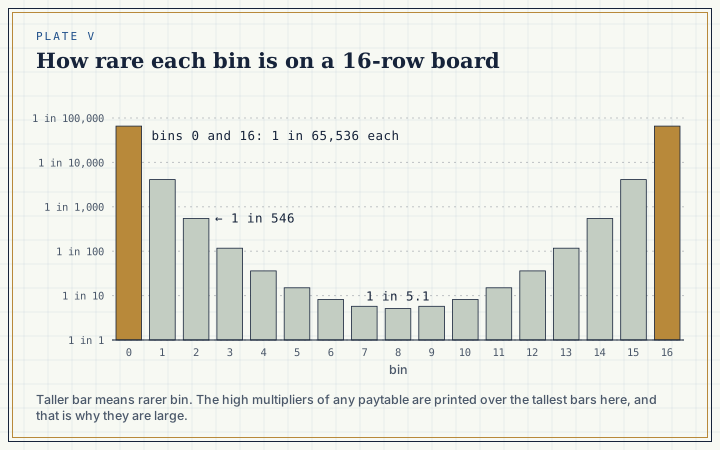
On a board where every peg splits evenly, that is one route out of 65,536 for each edge. Either edge together is 2 routes, or 1 in 32,768 drops. Some numbers help to make that concrete:
- In 1,000 drops, the chance of seeing either edge at least once is about 3.0%.
- In 10,000 drops, it is about 26.3%.
- To pass an even chance of seeing one particular edge, about 45,400 drops are needed.
At one drop every two seconds without a pause, 45,400 drops take a little over 25 hours. The top value is real, but for most sessions it stays a number on the screen.
Plinko 1000x: what the search is really asking
People type plinko 1000x when they want to know whether a board can multiply a stake a thousand times, and how likely that is. The answer has two parts, and both can be checked without trusting anyone's claim.
First, whether such a bin exists is a question for the game's own paytable. The top value a studio prints appears under the edge bins for each combination of rows and risk level, and often on the game's information screen as well. If the printed table does not show it, the board does not have it.
Studio pages differ in what they print here. Read on 16 September 2026, BGaming's Plinko page gives a maximum multiplier of 1,000×. Hacksaw Gaming's Plinko page gives a maximum win of 3,843.3×. Spribe's Plinko page prints a return figure and no top value, so none is stated here for it. What each studio prints about its board is gathered on the page about the studios behind the game.
Second, the arithmetic of reaching it. Suppose, as a hypothetical, a 16-row table printed 1,000× on each edge. The chance of either edge is 2 in 65,536, so that bin pair would add 1,000 times 2 divided by 65,536, about 3.05 percentage points, to the table's return. A search for plinko 1000x is, in effect, a question about the rarest two routes on the board.
A made-up 16-row table, summed bin by bin
The long-run return of a paytable is the probability of each bin multiplied by its value, added up across the board. Here is a made-up example of a 16-row table, read from the edge to the centre: 500×, 60×, 15×, 6×, 2.5×, 1.3×, 1×, 0.5×, 0.2×. Each line below is part of that example, with paired bins counted together:
- Example edge pair at 500×: 2 routes, adding 1.53 points.
- Second pair at 60×: 32 routes, adding 2.93 points.
- Third pair at 15×: 240 routes, adding 5.49 points.
- Fourth pair at 6×: 1,120 routes, adding 10.25 points.
- Fifth pair at 2.5×: 3,640 routes, adding 13.89 points.
- Sixth pair at 1.3×: 8,736 routes, adding 17.33 points.
- Seventh pair at 1×: 16,016 routes, adding 24.44 points.
- Eighth pair at 0.5×: 22,880 routes, adding 17.46 points.
- Centre bin at 0.2×: 12,870 routes, adding 3.93 points.
The total for this example is 97.24%. Look at the first line against the rest. The edge value is the number that catches the eye, yet in this made-up table it supplies about one and a half points of the 97. The seventh pair, printed a plain 1×, supplies sixteen times as much, simply because the ball lands there so often.
What the weighted sum teaches
Three lessons follow from that example, and they apply to any real table you read.
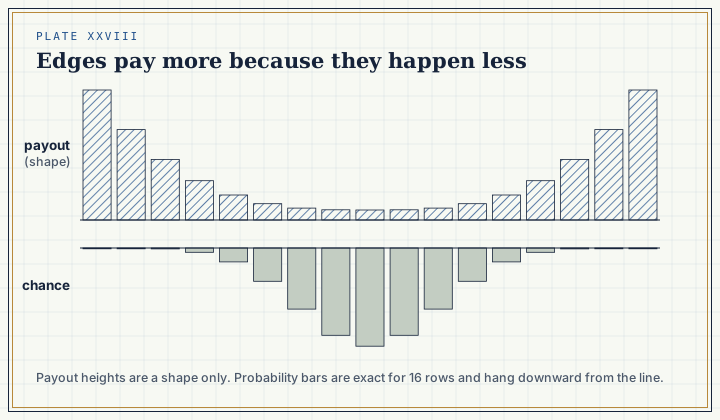
- The return is spread across the whole board. Changing one edge value moves the total only slightly; changing a busy central value moves it a lot.
- A large top value is paid for somewhere. For a table to keep a similar return while raising its edges, the inner bins must print less. That is the trade described on the risk settings page.
- The published return is the figure to compare. Two tables with very different top values can have near-identical returns. The top value tells you about the swings, not about the cost per drop.
Checking a real paytable yourself
You can repeat the sum on any board whose values are visible, and it takes about five minutes with a phone calculator. Write down each plinko multiplier from edge to centre for your chosen rows and risk level. Multiply each by its route count, doubled for the paired bins. Add the lot and divide by 2ⁿ. The result should sit close to the return figure the studio publishes for that setting, if it publishes one; a small gap usually comes from values rounded on screen.
The route counts for 8, 12 and 16 rows are listed on the probability tables page.
Remember too that a casino's own terms can cap what a single bet or a single day's withdrawal may pay out, whatever the board shows. Those caps belong to the account, not the game, and are covered on the page about withdrawal limits.
Reading a plinko multiplier without the hype
A big printed value is part of the table's design, not a target that becomes more likely with patience. Every drop has the same tiny chance of reaching the edge, and no app, pattern or timing can change that. Gambling is for adults aged 18 and over; decide what a session may cost before looking at the top of the table.