Same pegs, other numbers
Plinko high risk explained: same drop, a different paytable
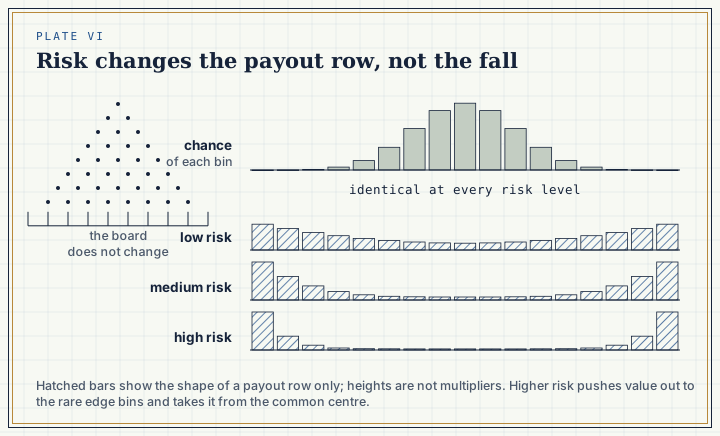
A risk setting leaves the ball's route exactly as it was and swaps the numbers printed under the bins. Two made-up paytables on one 8-row board show what that does to single drops and to a run of a hundred.
Plinko risk settings look as if they change the game, and in one sense they do, but not in the place most people expect. The pegs, the routes and the chance of every bin stay the same whichever setting is selected. What moves is the paytable: the row of multipliers printed under the bins. This page puts two invented paytables under the same board and follows the consequences through a single drop and then through a hundred.
What plinko risk settings actually swap
Picture the board as two layers. The top layer is the pegs, and it decides where the ball lands; on 8 rows the centre bin is reached 27.3% of the time and each edge 0.39%, whatever the menu says. The bottom layer is the list of multipliers, and it decides what that landing is worth. Neither layer says anything about which casinos actually list Plinko or how their account rules compare, a separate comparison kept on the plinko casinos page.
A risk control replaces the bottom layer and nothing else. You can check this on any board with a visible paytable: change the setting and watch the numbers under the bins change while the peg triangle stays put. The walk-through of one drop covers the top layer in detail.
The wording on a game's own menu, and how many settings it offers, is whatever its studio chose. Two studio pages read on 16 September 2026 show the variety: BGaming names three levels, high, normal and low, and Hacksaw Gaming names low, medium and high. On this page the words calm and steep describe the two example tables only; they are not the labels of any particular game's menu.
Two made-up paytables on one 8-row board
Both tables below are invented for illustration. They read from the edge bin towards the centre, and the other half of the board repeats them in reverse. The route counts are the same for both, because the board is the same: each edge has 1 route of 256, the next bin 8, then 28, then 56, and the centre 70. Paired bins on the two sides are grouped together in the sums.
The calm example
6×, 2×, 1.2×, 0.9×, 0.5×.
Working out the long-run return, bin group by bin group, with the route counts 2, 16, 56, 112 and 70 out of 256:
- Edges: 2 routes at 6× add 4.69 points.
- Next pair: 16 routes at 2× add 12.50 points.
- Third pair: 56 routes at 1.2× add 26.25 points.
- Fourth pair: 112 routes at 0.9× add 39.38 points.
- Centre: 70 routes at 0.5× add 13.67 points.
The total for this example is 96.48%.
The steep example
26×, 4×, 1.5×, 0.3×, 0.2×.
The same route counts give:
- Edges: 2 routes at 26× add 20.31 points.
- Next pair: 16 routes at 4× add 25.00 points.
- Third pair: 56 routes at 1.5× add 32.81 points.
- Fourth pair: 112 routes at 0.3× add 13.13 points.
- Centre: 70 routes at 0.2× add 5.47 points.
The total for this example is 96.72%.
So the two invented tables hand back almost exactly the same share of stakes over a very long run. In both, the six outer bins pay more than the stake, and in both those bins are reached 28.9% of the time. The difference lies entirely in how the return is distributed across the board.
Where the return lives on a plinko high risk table
Look at where each table earns its total. In the calm example, the two bins either side of the centre supply the largest share, 39.38 points, and the edges supply less than 5. In the steep example, the outer six bins supply 78.12 points between them, and the whole central zone, where 71.1% of drops end, supplies just 18.60.
That is the essence of a plinko high risk table. Most drops land in bins that return a small fraction of the stake, and the return is held back for rarer bins further out. The average is similar; the experience is not.
Put in terms of a single US$1 drop:
- A losing drop on the calm example returns 90 cents or 50 cents.
- A losing drop on the steep example returns 30 cents or 20 cents.
- A winning drop on the calm example returns at most US$6.
- A winning drop on the steep example can return US$26, about once in 128 drops on average.
Variance: the number the return figure leaves out
The spread of results around the average is measured by the standard deviation. For one US$1 drop, the calm example has a standard deviation of about 58 cents; the steep example, about US$2.43. The long-run return figure is nearly the same, yet one table swings about four times as widely as the other.
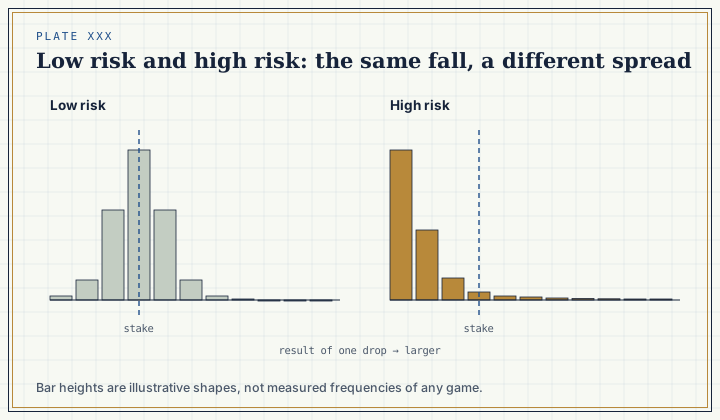
Spreads grow with the square root of the number of drops. After 100 drops, the calm example's spread is about US$5.81 around an expected loss of about US$3.52, while the steep example's spread is about US$24.27 around an expected loss of about US$3.28.
Counting the actual outcomes over 100 drops at US$1 each gives a clearer picture:
- Calm example: about a 25.1% chance of finishing ahead, and practically no chance of being down US$20 or more.
- Steep example: about a 39.7% chance of finishing ahead, and about a 29.2% chance of being down US$20 or more.
Neither table is kinder in the long run. The steep one simply produces more sessions that end well above the start and more that end well below it. For a player searching plinko high risk, that is the trade to understand before choosing.
Rows and risk together
Risk and height are independent controls, and a board that offers both needs a paytable for every combination. Taller boards push the edges further out: on 16 rows each edge is reached once in 65,536 drops rather than once in 256. A steep table on a tall board therefore concentrates its return in bins that most sessions never reach. The row count page works through those edge chances.
The chance of each bin is listed for 8, 12 and 16 rows on the probability tables page. The weight of the top values in the total is worked through on the multiplier page.
Choosing among plinko risk settings
No setting improves the long-run return by being chosen at the right moment, and no setting makes the next bin knowable. What a setting does change is how quickly a budget can move in either direction. A few practical checks help:
- Read the paytable for the exact rows and risk level you intend to use; it changes with both.
- Look up the return figure the studio publishes for that setting on the game's information screen, if it gives one.
- Compare your budget with the standard deviation of a drop. A steep table can empty a small budget long before its rare bins have a realistic chance to appear.
- If you want a steadier session, a calmer table does that; it does not make the session cheaper on average.
Published return figures also come in different shapes. On their own Plinko pages, read 16 September 2026, Spribe prints an RTP of 97% and BGaming prints 99%, each as a single number. Hacksaw Gaming prints a list of seven RTP values, running from 98.98% to 88.20%, rather than one figure, so the value for the board in front of you is worth confirming on its information screen.
Gambling is for adults aged 18 and over. Set a limit before choosing a risk level, not after a run of results.