Drops on repeat
Plinko autoplay in numbers: turnover, stop rules and the cost of an hour
Autoplay does not touch the pegs or the paytable. It changes how many drops fit into an hour, and so how much is staked. Stop rules decide when a run ends, not what each drop is worth.
Plinko autoplay is the control that repeats drops for you at the rows, risk level and stake you have already chosen. It feels like a mode of its own, but from the board's point of view nothing is different: each ball still makes one left-or-right choice per row and lands in a bin with the same chance as a ball dropped by hand. What changes is pace, and pace is where the money goes.
What stays exactly the same
Start with the parts of the machine autoplay cannot reach.
- The routes. On 8 rows the centre bin still takes 70 of 256 routes and each edge one. On 16 rows each edge is still one route of 65,536, as the bin-by-bin chances show.
- The paytable. The numbers under the bins are set by the rows and the risk level, not by who presses the button.
- The return. The long-run share of stakes handed back is the weighted sum of the paytable, whether drops are started one at a time or a hundred in a row. The page on multiplier tables shows that sum in full.
- Independence. A drop has no memory of the drop before it, so a long automatic run carries no pattern that a manual run lacks.
The walk-through of a single drop covers those mechanics in detail.
What plinko autoplay does change: turnover
Turnover is the total amount staked over a period. The expected cost of playing is turnover multiplied by the share the paytable keeps. Double the turnover and, on average, you double the cost, even though no single drop has become more expensive.
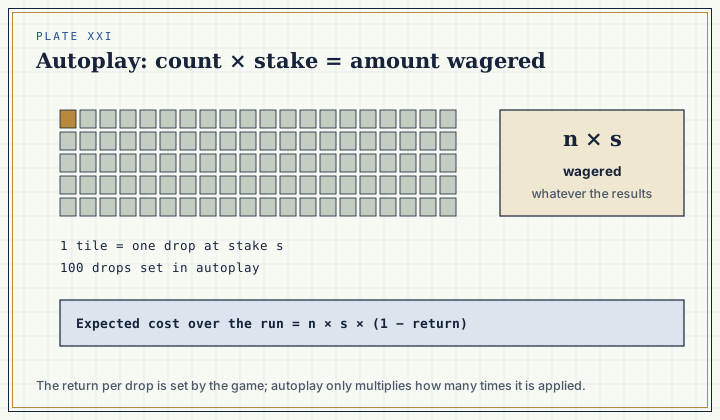
A worked example makes this concrete. Assume a made-up board that returns 97% over the long run, a stake of US$0.50, and one hour of play:
- By hand, at a hypothetical 10 drops a minute: 600 drops, US$300 staked, an expected cost of about US$9.
- On autoplay, at a hypothetical 40 drops a minute: 2,400 drops, US$1,200 staked, an expected cost of about US$36.
Nothing about the board got worse between the two lines. The hour simply held four times as many drops. Some boards add a faster animation option on top, which shortens each drop again and raises the count further.
Stop rules: limits, not levers
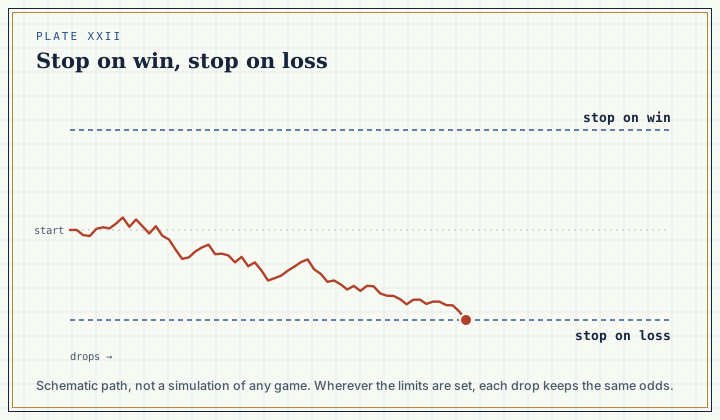
Autoplay panels often let you end a run early. The details differ from game to game, but the usual choices look like this:
- Number of drops. The run ends after a set count, such as 100.
- Loss stop. The run ends once the balance has fallen by a chosen amount.
- Win stop. The run ends once the balance has risen by a chosen amount.
- Single-win stop. The run ends when one drop pays more than a chosen amount.
These controls are useful, and it is worth being precise about what kind of useful. They end a run. They do not change the chance of any bin, the value of any bin or the average cost of a drop.
A loss stop, worked through
Take the made-up 97% board again, with US$0.50 drops and a loss stop at US$20. The expected cost per drop is 1.5 cents, so on average a run would take about 1,300 drops to lose US$20. In practice the spread of results means some runs reach the stop much sooner and some drift upwards for a long time first. The stop does not make losing less likely; it puts a ceiling on how much a single run can lose.
A win stop, worked through
Now set a win stop at US$10 on the same board. Some runs will reach it and end with a gain. Others will never reach it and carry on until the drop count or the loss stop ends them. Across many runs, the average cost is still 1.5 cents per drop played. A win stop decides when to walk away, not whether walking away is profitable on average.
The size of those swings depends on the paytable. A steep table reaches both stops sooner than a calm one, for reasons set out on the page on risk settings.
Using plinko autoplay as a budgeting tool
Read that way, the panel is less a way to play and more a way to set limits in advance. A few habits help:
- Set the drop count from the budget. If a session budget is US$20 and the stake is US$0.50, a run of 40 drops cannot stake more than the budget even if every drop returns nothing.
- Pair a loss stop with a drop count. The loss stop caps the damage; the drop count caps the time.
- Treat a win stop as a moment to pause, not as a target the next run should beat.
- Check the rows and risk before pressing start. Autoplay repeats whatever is selected, including a steep table you meant to change.
No run length, stop value or sequence of stakes turns a board with a return below 100% into one that pays over time. Changing stakes up after losses only raises turnover when balances are lowest.
Gambling is for adults aged 18 and over. If runs keep getting longer than planned, stepping away is the sensible choice, and Gamblers Anonymous meets in many countries.